
PET Silicone Tape Log & Jumbo Rolls: Converter Buying Guide
Buying PET silicone tape in log or jumbo rolls is a different job from approving a masking tape. A sample strip can come out of the bake test clean, with a sharp edge and no residue, and the first log can still refuse to slide onto your lathe mandrel, lose a lane to edge trim, or carry one splice into every roll you cut from it.
This guide is for converters and private-label distributors who slit or rewind the tape themselves. If you are choosing a tape for a coating line instead, start with the powder coating masking guide.
One rule runs through everything below: “log,” “jumbo” and “master roll” are sales words. Order by dimensions, defect rules and test methods both sides have agreed in writing.
A clean bake test is only half the approval
There are two approvals here, and they answer different questions.
| Tape approval: will it mask? | Roll approval: will it run? |
| Heat exposure under your real time-temperature profile | Nominal width versus usable width after trim |
| Peel adhesion by a named method | Thickness profile across and along the web |
| Clean removal and edge line after bake | Winding hardness, telescoping, dishing |
| Backing strength and elongation | Splice count and position |
| Behavior on the actual substrate | Slit-face quality, edge ooze, unwind force, core fit |
A hand-cut strip speaks to the left column and says very little about the right one. It is a small patch, often from the outer wraps, and it has not been through winding tension, a knife, months in a warehouse or a container crossing.
Thickness variation is a good example of what a strip hides. Mactac’s tape troubleshooting notes describe how cross-web or down-web variation in the carrier, liner or adhesive coating can leave material “baggy” at the converter, so it tracks poorly and forms hard wrinkles over machine rolls. You won’t find that on a lab strip. You’ll find it on the rewinder.
For the tape side (heat window, adhesive family, residue), see PET versus polyimide tape for powder coating and residue after bake. The rest of this article is about the roll.
Log roll vs jumbo roll: the names won’t protect you
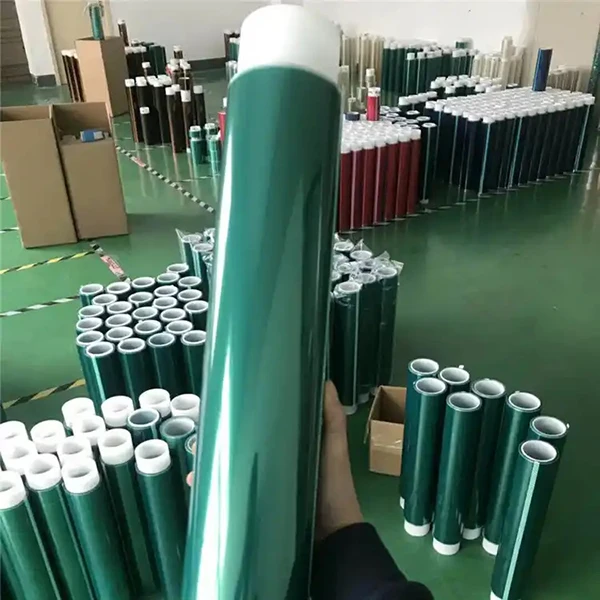
In one common usage, a jumbo roll is the wide master roll coming off a coating or laminating line, while a log roll has already been rewound to a set width and length; a jumbo has to be rewound into logs before it can be log-slit (TapeSlitterPro). Others use “log” for any large, wide roll a tape maker ships, simply because it looks like a tree trunk (Tom Brown Inc.).
Published listings add to the blur. One major manufacturer sells a green polyester/silicone tape at 48 in × 72 yd: full width, but already at a standard finished-roll length. Jumbo or log? Depends who you ask.
So when a quote says “jumbo,” get the numbers behind the word. At minimum, the order should state:
| Field | What to put on the order |
| Width | Nominal width, tolerance and minimum usable width after trim |
| Length | Net tape length, tolerance and how it is measured |
| Outside diameter | Maximum OD your mandrel or unwind stand accepts, with room for length tolerance |
| Roll weight | Maximum net and gross weight for your hoist and unwind |
| Core | Inside diameter, material, wall thickness, core width and tolerance |
| Winding direction | Adhesive in or out; add a sketch if there is any doubt |
| Liner | Self-wound or linered; liner type and thickness if used |
| Roll build | Face alignment, hardness range or an agreed visual standard |
For the width and length rows, ASTM’s D5750/D5750M guide covers tolerances and labeling, and recommends citing it wherever widths and lengths are stated in contracts, orders and labels.
Start from the slitter, then choose the roll
Your equipment, not the price list, decides which supply form of PET silicone tape makes sense.
Log (lathe) slitting spins the wound roll on a mandrel while a knife plunges through it. Because nothing is unwound, it is generally faster and cheaper than rewind slitting, needs no tension control and can reach very narrow widths (Sollex).
Rewind slitting unwinds the web, slits it into lanes and rewinds each lane. It is the more versatile of the two and holds tighter tolerances (Strouse).
| What you run | Supply form that normally fits | Confirm before ordering |
| Lathe / log slitter | Log wound to your finished-roll length | Max log OD and width, core ID and wall, mandrel fit, minimum slit width, acceptable face quality |
| Slitter-rewinder | Long-length jumbo or parent roll | Max unwind OD, weight and web width, shaft or chuck spec, brake range, web guiding, rewind cores |
| One machine, but the attractive price is on the other format | Rewinding by the supplier or a third party | Who rewinds, added splices, final OD and roll build, lead time, who owns winding defects |
That last row is an easy trap. A buyer who only runs a lathe sees a better price per square metre on long parent rolls and orders them. Someone then has to rewind them into logs, which brings extra splices, extra lead time and a third party into any argument about the result. Price the rewinding in before choosing.
Plan the trial around the knife as well. A PSTC conference paper on adhesives for film-based tapes and labels says adhesive buildup on slitting knives is almost always a concern, is more common with softer adhesives on warm days, and depends heavily on line speed, temperature, humidity, web tension and knife condition. The paper is not specific to silicone adhesives, so treat it as a checklist, not a prediction.
The 20 mm that decides your yield
Coated webs often need edge trim, so the width on the quote is not automatically the width you can sell. Put three things on the order: whether edges arrive trimmed, the guaranteed usable width, and how much edge waste you expect to take on your own machine.
Here is the arithmetic, with illustrative numbers rather than any product’s specification. Two suppliers both quote 1,040 mm. One guarantees 1,020 mm usable; the other guarantees 1,000 mm. Slitting 50 mm lanes, both give you twenty rolls on paper. The first leaves 20 mm of margin. The second leaves none, so a single damaged edge costs a lane and output falls from 20 rolls to 19 on that log, a 5% loss.
That is how a cheaper square metre turns into a more expensive saleable roll.
One splice in a log, twenty defective rolls
Length first. State net length, tolerance and measuring method. A meter counter and a weight calculation are not the same measurement, because weight also moves with coat weight and backing variation.
Now splices. In a log, a splice runs across the full width at one point in the wound length. The lathe cuts straight through it, so every finished roll from that log carries the splice at the same place. Nobody at the slitter sees it. It turns up weeks later, halfway down a roll, on your customer’s masking bench.
Your splice rules should cover:
- maximum splices per roll, and minimum spacing between splices and from either end;
- splice construction and materials;
- whether each splice is flagged at the roll edge; and
- whether the label reports splice count and position, so spliced logs can be set aside before slitting.
Labels should also carry product code, lot, manufacturing date, size, net length and a unique roll number that traces back to production and inspection records.
Where to put the micrometer
On a PET silicone tape, “50 micron” can mean the PET backing or the whole construction. Put both on the spec, say whether any liner is included, and give each a tolerance.
One reading in the middle of the web tells you almost nothing about bagginess or gauge bands. Take left, center and right readings across the usable width, at the outer wraps, mid-roll and near the core.
For the method, ASTM D3652/D3652M covers tape thickness and states that it is useful for quality control and acceptance testing against specifications; PSTC-133 is the PSTC thickness method many tape data sheets cite. A method is not a limit, though. The minimum and maximum still have to be written down.
Check the roll before it touches a mandrel
Incoming inspection starts on the pallet, not at the machine.
Telescoping is lateral slip between wraps. It comes down to torque capacity, which depends on layer-to-layer friction, interlayer pressure and the ratio of roll OD to core OD, and it happens more often during unwinding than winding (PFFC). A large OD on a small core deserves a machine trial, not just a visual check.
Crushed cores may not show until the shaft comes out, or until the roll has been handled, shipped or stored (Dover Flexo Electronics).
For each received roll, record:
- faces and core: flat, aligned faces; a round, undamaged core that fits your mandrel or chuck;
- winding and edges: loose wraps, gauge bands, impact damage, adhesive ooze or tacky faces;
- a short manual unwind: smooth, with no blocking, adhesive transfer or unusual force; and
- label data against the purchase order and packing list.
Photograph the pallet and roll faces before you cut the stretch wrap. It is the only clean way to separate freight damage from what happens later in your own plant.
A trial slit that samples the whole roll
Qualify across the roll’s radius and across its width:
- Take material from the outer, middle and near-core wraps, checking left, center and right at each depth.
- Run it on the lathe or slitter-rewinder you will use in production, and record knife, speed, lubrication and tension settings.
- Record slit-face quality, width, knife buildup, finished-roll alignment and unwind behavior.
- Take finished rolls cut from different positions and run the bake, removal and edge-line test on the substrate your customers actually coat.
One variable many trials leave out is time. A PFFC web-handling column notes that rolls may loosen over time and suggests testing some after a storage period representative of what the customer will see. In practice: hold back a few finished rolls from the trial and unwind them again a few weeks later.
Then write the pass/fail criteria into a controlled acceptance specification. “Trial passed” means nothing a year later unless the record shows sample identity, machine settings, conditions and the limits used.
TDS, COA and your purchase spec cover different ground
| Document | What it can show | What it cannot prove on its own |
| Technical data sheet (TDS) | Construction, typical properties, suggested uses, general storage guidance | That any listed value is guaranteed for your lot |
| Certificate of analysis (COA) or agreed lot test report | Results for named attributes, tested by stated methods against stated limits | Fit on your mandrel or behavior on your knife |
| Your acceptance specification | Agreed properties, limits, methods, sampling, defect rules, records and disposition | Conformity, unless the inspections are actually done and traceable |
3M’s TDS-versus-COA explanation puts it plainly: TDS data are representative or typical and not for specification purposes, while the COA carries the specifications, test methods and results the product is supplied against.
Named methods keep both sides measuring the same thing: ASTM D3330/D3330M or PSTC-101 for peel, ASTM D3759/D3759M or PSTC-131 for breaking strength and elongation, ASTM D3811/D3811M for unwind force, and ASTM D3652/D3652M or PSTC-133 for thickness. Add the method variant, units, conditioning, sample count and limits.
During quotation, ask exactly which lot records will ship with the PET silicone grade you are buying, and check the published datasheets for construction details. A TDS on file is not a batch certificate.
Ocean freight belongs in the spec
Storage guidance is product-specific. The TDS for one widely used green polyester/silicone masking tape calls for original packaging, 16–27 °C, 40–60% relative humidity, and use within 24 months of manufacture. Those figures belong to that product, not to PET silicone tape in general, so get the manufacturing date on every label and your grade’s storage conditions and shelf life in writing.
Now compare that window with a steel box on a ship. A public-health study of container buildings cites shipboard measurements showing temperatures inside shipping containers can exceed 60 °C.
Heat does more than soften adhesive. A patent filing on wound rolls describes telescoping in transport and storage when ambient temperature runs above production temperature: the resin core and the wound web expand differently, winding pressure rises, and the layers shift. It also reports that moisture-proof wrapping alone did not reliably prevent it. That work concerns resin cores, so treat it as a mechanism to watch for rather than a rule for every roll.
For the supply order, agree roll orientation, face and core protection, pallet restraint and moisture control, and ask for packing photos before the first shipment. On long or hot routes, discuss seasonal timing and whether thermal protection is worth the cost.
When a roll fails, collect evidence before assigning blame
Record lot and roll numbers, photos, the defect’s position across the width and along the roll, machine settings, storage history and affected quantity, and keep untouched supply-roll samples alongside converted ones. The supply agreement should already say how long you have to report a problem, who runs the confirmation test and which method controls. Settling that before the first order is far easier than settling it over a rejected container.
RFQ checklist for PET silicone tape supply rolls
Send these details before asking for a final price:
- Equipment: lathe slitter, slitter-rewinder or both
- Maximum unwind or log OD, roll weight, web width, and mandrel or chuck dimensions
- Core requirements and winding direction
- Target finished widths and lengths, total quantity and delivery schedule
- Nominal width, guaranteed usable width and trim allowance
- Maximum splice count, spacing, flagging and label requirements
- Thickness construction, tolerance, method and sampling plan
- Required TDS, lot records and acceptance specification
- Packaging, pallet and private-label requirements
- The process your customers will run the finished tape through, such as powder coating bake conditions
With those numbers in hand, send them to our team. We will check which roll format fits your slitter before quoting, and tell you plainly if a format or dimension is outside what we can supply.
FAQ
Only if the landed cost still wins after rewinding. Someone has to turn the jumbo into logs at your finished length, which adds a process step, possible splices and another party responsible for winding quality. If you go that way, specify the rewound log exactly as you would a direct log: OD, core, splice rules and roll build.
It depends on the evidence. Heat in transit, storage time, winding pressure and your own slitting setup can all contribute. Check your slitting record and warehouse history first. If your arrival photos show ooze on the supply-roll faces before slitting, that is a different conversation. Agree in advance who tests retained samples and by which method.
There is no universal number. Work backwards from finished rolls: splices per log multiplied by lanes per log gives the number of finished rolls carrying a splice. Then decide what your customers will accept, whether flagged logs can be segregated before slitting, and whether spliced rolls can be sold as a separate grade.
It can reduce it, not replace it. The COA covers the attributes both sides agreed, measured on that lot. It says nothing about fit on your mandrel or behavior on your knife. After a run of conforming lots you might agree a lighter check, but keep dimensional and visual checks on every roll.
Treat it as a new construction until a trial slit and bake test say otherwise. That is why written change notification belongs in the supply agreement, especially if the tape goes out under your own brand: you want to hear about it before the lot arrives, not after finished rolls come back.
Related Articles:
- Powder Coating Tape Leaves Residue After Bake: What to Check First
- How to Choose Powder Coating Masking Tape: Edge Lines, Residue, and Heat Exposure
- Polyester Tape vs Polyimide Tape for Powder Coating: When Is Higher Heat Resistance Worth It?
- What Is Polyester Silicone Tape? Properties, Uses, and Industrial Applications
- Polyester Silicone Tape Uses in Powder Coating, Anodizing, Chemical Masking, and Surface Protection
References
· Mactac — Tape Troubleshooting
· 3M — Polyester Tape 8402, Green, 48 in x 72 yd (product listing)
· 3M — Polyester Tape 8992/8992L Technical Data
· 3M — eBonding Technical Resources (TDS vs COA)
· ASTM D5750/D5750M-95(2020) — Width and Length of Pressure-Sensitive Tape
· ASTM D3652/D3652M-01(2020) — Thickness of Pressure-Sensitive Tapes
· ASTM D3330/D3330M-04(2025) — Peel Adhesion of Pressure-Sensitive Tape
· ASTM D3759/D3759M-05(2025) — Breaking Strength and Elongation of Pressure-Sensitive Tape
· PSTC — Test Methods for Pressure Sensitive Adhesive Tapes
· PSTC — Identifying the Right Pressure Sensitive Adhesives for Filmic Applications
· PFFC — Winding Part 5: Solutions for Common Wound Roll Defects
· PFFC — Should Unwind Tension Be Lower Than Winding Tension?
· Dover Flexo Electronics — Common Roll Winding Defects
· Sollex — Log (Lathe) Slitting Method Overview
· Strouse — Which Roll Slitting Method Is Best?
· Tom Brown Inc. — Understanding the Art and Science of Log Slitting
· TapeSlitterPro — Double Sided Tape Slitting Process
· Container buildings in Johannesburg and heat-related health risks (PMC)

