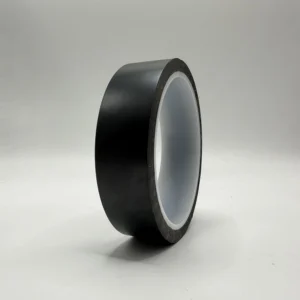
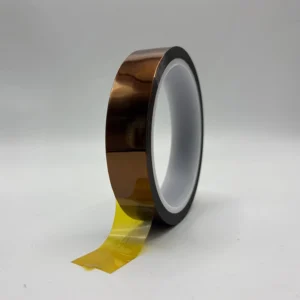
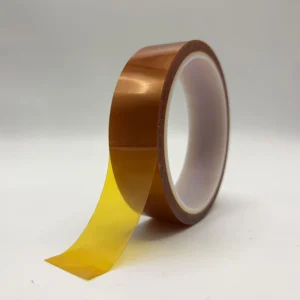
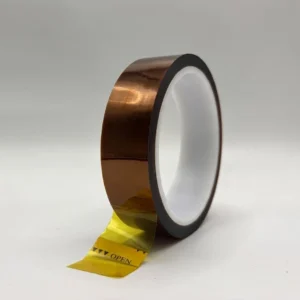
K-610 acrylic polyimide tape is an amber, single-sided polyimide tape with a non-silicone acrylic adhesive. Neither the adhesive nor the back of the film contains silicone. The tape is used for lithium-ion battery tab protection and for coil and lead wrapping in motors and transformers. It comes in two grades, approx. 2.2 and 3.1 mil (0.055 and 0.08 mm) total thickness, and is rated at 311°F (155°C) for 30 minutes in a laboratory oven test.
- Grades: K-610-055, K-610-08
- Total thickness: approx. 2.2 and 3.1 mil (0.055 and 0.08 mm); film approx. 1 and 2 mil (0.025 and 0.050 mm)
- Adhesion to steel: ≥25 / ≥27 oz/in (≥7 / ≥7.5 N/25 mm)
- Temperature resistance: 311°F (155°C) for 30 min, oven test
- Rolls: approx. 36 yd and 72 yd (33 m and 66 m); slit to your width
- Core: 3 in (76 mm) plastic; no release liner
Request a quote or free sample
On This Page
- Construction and Key Features
- Grade Specifications
- Acrylic or Silicone Polyimide Tape?
- Acrylic Polyimide Tape Terminology
- Applications by Industry
- Selection and Validation Checklist
- Common Application Problems and Solutions
- Ordering, MOQ and Lead Time
- Converting and Customization
- Manufacturing and Quality Control
- Tools and Downloads
- Frequently Asked Questions
- Request a Quote
Construction and Key Features
The amber polyimide film backing is approx. 1.0 mil (0.025 mm) in K-610-055 and approx. 2.0 mil (0.050 mm) in K-610-08.
The single-sided acrylic pressure-sensitive adhesive is non-silicone and approx. 1.2 mil (0.030 mm) in both grades. Neither the adhesive nor the back of the film contains silicone. There is no release liner; the tape is wound directly on the core.

Grade Specifications
Values marked ≥ are guaranteed minimum values; thickness values are nominal. US customary values are converted from metric. Validate the tape on your actual substrate, temperature profile and dwell time. Download the K-610 TDS (PDF).
| Grade | Total Thickness | Film Thickness | Adhesive Thickness |
|---|---|---|---|
| K-610-055 | approx. 2.2 mil (0.055 mm) | approx. 1.0 mil (0.025 mm) | approx. 1.2 mil (0.030 mm) |
| K-610-08 | approx. 3.1 mil (0.08 mm) | approx. 2.0 mil (0.050 mm) | approx. 1.2 mil (0.030 mm) |
| Grade | Adhesion to Steel | Tensile Strength | Elongation at Break | Dielectric Breakdown Voltage | Temperature Resistance |
|---|---|---|---|---|---|
| K-610-055 | ≥25 oz/in (≥7 N/25 mm) | ≥22.8 lb/in (≥40 N/10 mm) | ≥55% | ≥4.0 kV | 311°F (155°C), 30 min |
| K-610-08 | ≥27 oz/in (≥7.5 N/25 mm) | ≥45.6 lb/in (≥80 N/10 mm) | ≥55% | ≥4.0 kV | 311°F (155°C), 30 min |
- Metric thickness values are nominal; performance values are guaranteed minimums; temperature resistance is a rating. US customary values are converted from metric; thickness is approximate and performance values are rounded down.
- Temperature resistance is a short-term rating of 311°F (155°C) for 30 minutes from a laboratory oven test. It is not a continuous or long-term service temperature, and not an insulation class.
- Dielectric breakdown voltage values are specified minimum values, not rated working voltages or insulation-system ratings.
Acrylic or Silicone Polyimide Tape?
| Factor | K-610 (this product) | K-620 |
|---|---|---|
| What it is | Polyimide film with non-silicone acrylic adhesive | Polyimide film with silicone adhesive |
| Temperature | 311°F (155°C) for 30 min | 500°F (260°C) for 30 min |
| Consider it when | Processes that do not allow silicone, such as lithium-ion battery tab protection; coil and lead wrapping where a UL- or CSA-recognized tape is not required; exposures within 311°F (155°C) for 30 minutes. For tape that stays in service, check operating temperature and aging. | Silicone adhesive is acceptable and the process needs higher temperatures, up to 500°F (260°C) for no more than 30 minutes per exposure, such as wave solder or powder coating masking |
| Not for | Wave solder, reflow, gold finger or powder coating masking | Processes that do not allow silicone |
K-610 is rated 311°F (155°C) for 30 minutes. If your process allows silicone and its peak temperature is higher but within 500°F (260°C), with each exposure lasting no more than 30 minutes, compare Silicone Polyimide Tape K-620. If an exposure lasts longer than 30 minutes, repeats, or the tape stays at temperature in service, neither 30-minute rating covers it: send us your temperature profile before choosing a tape. Do the same if silicone is not allowed and your process exceeds K-610’s rating. For a closer look at the two adhesive systems, see Silicone vs Acrylic Adhesive Polyimide Tape. To browse the full range, see all polyimide tape products.
Acrylic Polyimide Tape Terminology
Polyimide tape is often shortened to PI tape. Buyers often call amber polyimide tape “Kapton tape”, after the Kapton® brand of polyimide film; this type is often searched as “Kapton tape with acrylic adhesive”. K-610 is made with Kapton® polyimide film and an acrylic pressure-sensitive adhesive. Because neither its adhesive nor the back of its film contains silicone, K-610 can be described as a non-silicone polyimide tape; an acrylic adhesive alone does not guarantee that a tape is silicone-free. “1 mil” or “2 mil” usually refers to the film, not the whole tape. K-610 grades use approx. 1 and 2 mil (0.025 and 0.050 mm) film, with a total thickness of approx. 2.2 and 3.1 mil (0.055 and 0.08 mm). See What Is Polyimide Tape?
Kapton® is a registered trademark of its respective owner. River Tape is not affiliated with or endorsed by the trademark owner.
Applications by Industry
| Industry | Application | Why This Tape | Recommended Grade |
|---|---|---|---|
| Battery manufacturing | Lithium-ion battery tab protection | Non-silicone acrylic adhesive on polyimide film. Validate adhesion and lifting in your own electrolyte and cell design. | K-610-055 |
| Motors, transformers and coils | Coil and lead wrapping | Dielectric breakdown voltage ≥4.0 kV (minimum). No UL or CSA recognition and no insulation class; 311°F (155°C) for 30 minutes is an oven test, not a long-term rating, so check your operating temperature and aging requirements. | K-610-08 |
For process guidance, see Electrical Insulation Tape Solutions, Motor & Transformer Insulation Solutions and the EV battery insulation tape guide.
Selection and Validation Checklist
The temperature rating and the minimum values on this page do not cover every process. Before approving K-610 for production, verify the following on your own parts and line.
| What to Verify | Why It Matters | How to Check |
|---|---|---|
| Temperature, dwell time and service life | K-610’s 311°F (155°C) value is a 30-minute oven test, not a long-term rating. Welding, drying or varnish curing can exceed it locally, and tape that stays in a winding or a cell also sees long-term operating temperature and aging. | Run the tape through your actual process, including repeated heat cycles; for permanent use, test at your operating temperature and against your aging requirements. If the peak temperature is higher but within 500°F (260°C), each exposure stays within 30 minutes and silicone is allowed, K-620 can be evaluated. For longer, repeated or continuous exposure, or where silicone is not allowed, send us the temperature profile. |
| Electrolyte, varnish and chemical exposure | Electrolyte formulations differ between cell designs, and varnishes and resins differ between winding lines. | Expose taped samples to your own electrolyte, varnish or resin at process temperature, then check adhesion, lifting and swelling. |
| Silicone restrictions | K-610’s adhesive and film back contain no silicone; other materials in your process may. | Check that your process specification covers every material in contact with the part. |
| Listing or insulation-class requirements | K-610 has no UL or CSA recognition and no insulation-class rating. | If your design or customer specification requires a listed tape or a thermal class, tell us before ordering. |
For how thermal classes apply to motors and transformers, see Electrical Insulation Classes for Tape Selection. For film thickness in coil, wire and component insulation, see Polyimide Tape Thickness for Electrical Insulation.
For background on requirements for polyimide film tapes used for electrical purposes, see IEC 60454-3-7. The standard covers specific types of polyimide film tape, so check its scope separately. This reference is general background and does not mean K-610 has been tested or certified to that standard.
Common Application Problems and Solutions
These are common issues when using polyimide tape in battery, winding and silicone-sensitive processes, with practical checks. They describe application issues, not recorded K-610 failures.
| Problem | Likely Cause | Solution |
|---|---|---|
| Tape lifts or shrinks back after a heat step | Exposure hotter or longer than the 311°F (155°C), 30-minute rating | Measure the actual temperature and dwell time. If only the temperature is higher, each exposure stays within 30 minutes and silicone is allowed, a silicone polyimide tape rated for that temperature for 30 minutes may suit. If exposure is longer or repeated, or silicone is not allowed, send us the temperature profile. |
| Coating or bonding defects near taped areas | Silicone transfer from a silicone-adhesive tape or another material used earlier in the process | Use a polyimide tape with a non-silicone adhesive and check other silicone sources. |
| Tape edge lifts at the tab after electrolyte filling | Electrolyte not validated for the adhesive, a contaminated surface, or low application pressure | Clean the surface, press the edges firmly, and validate in your electrolyte before production. |
Ordering, MOQ and Lead Time
| Item | Details |
|---|---|
| Width | Slit to the width you need; log rolls approx. 39 in (1,000 mm) wide |
| Roll lengths | Approx. 36 yd and 72 yd (33 m and 66 m); supplied in metric lengths |
| Core inner diameter | 3 in (76 mm) |
| Core material | Plastic |
| Release liner | None |
| Packaging | Label, OPP bag, PVC box, carton, or custom packing |
| MOQ | 10,764 ft² (1,000 m²) per thickness grade |
| Lead time | 7–15 days (production time, counted from receipt of payment) |
| Sample policy | Free samples in small quantities; freight paid by the customer |
| Shelf life | 12 months from date of manufacture |
| Storage | In the original packaging in a cool, dry place away from direct sunlight and moisture |
Minimum order is measured by tape area for each thickness grade. For example, at 1 in (25.4 mm) width, 10,764 ft² (1,000 m²) is at least 1,194 rolls of 36 yd (33 m) or 597 rolls of 72 yd (66 m). Send your widths and roll length and we will confirm the roll count. Different widths of the same grade can be combined toward the minimum.
Lead time = production time, excluding transit. EXW, FOB and CIF are all available.
For volume supply and custom slitting, see our polyimide tape manufacturer page.
Converting and Customization
- Slitting to width
- Log / jumbo rolls (log roll width approx. 39 in (1,000 mm))
- Logo or label printing
- OEM packaging and private label
Manufacturing and Quality Control
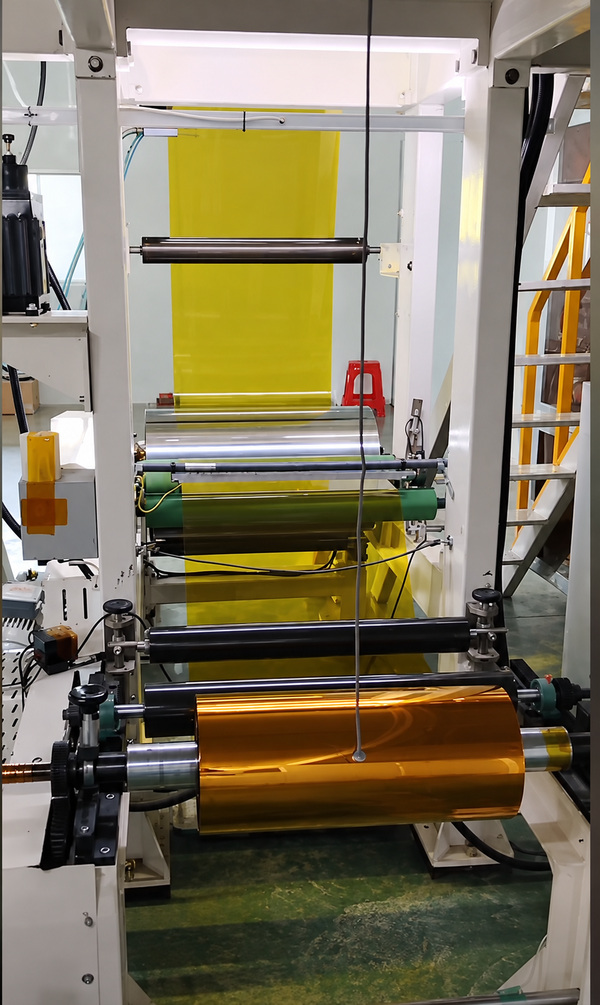
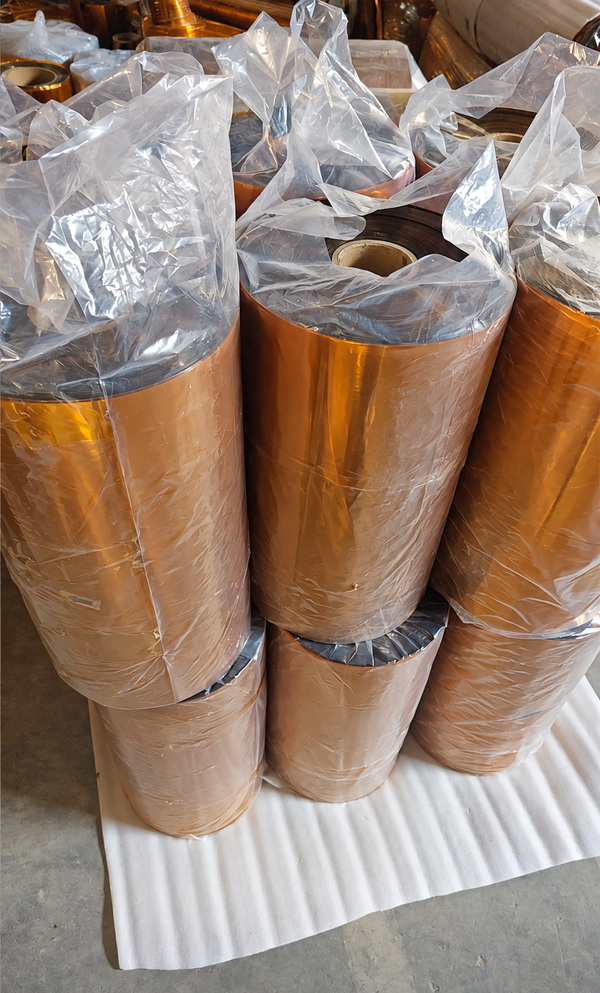
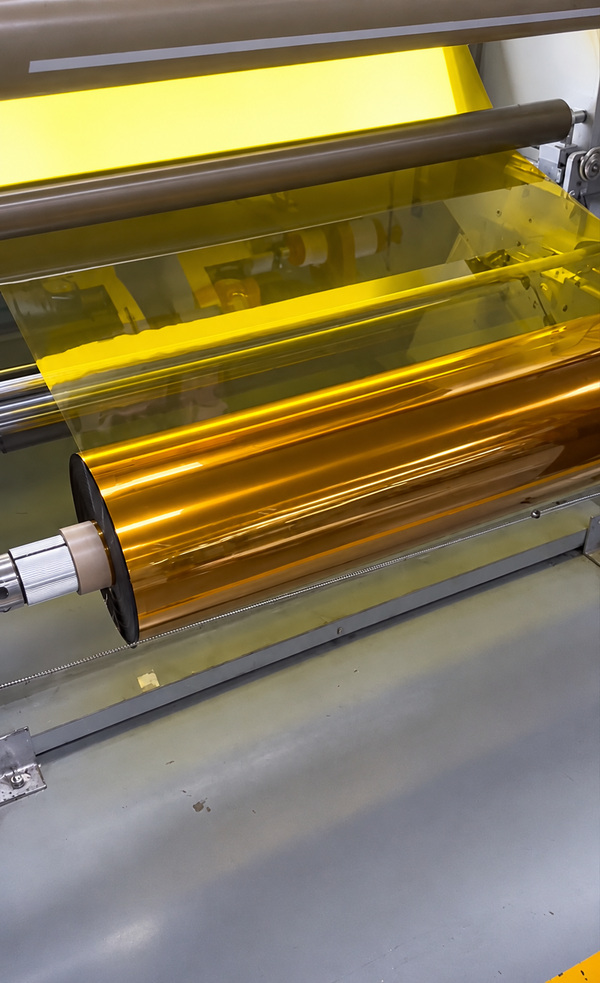
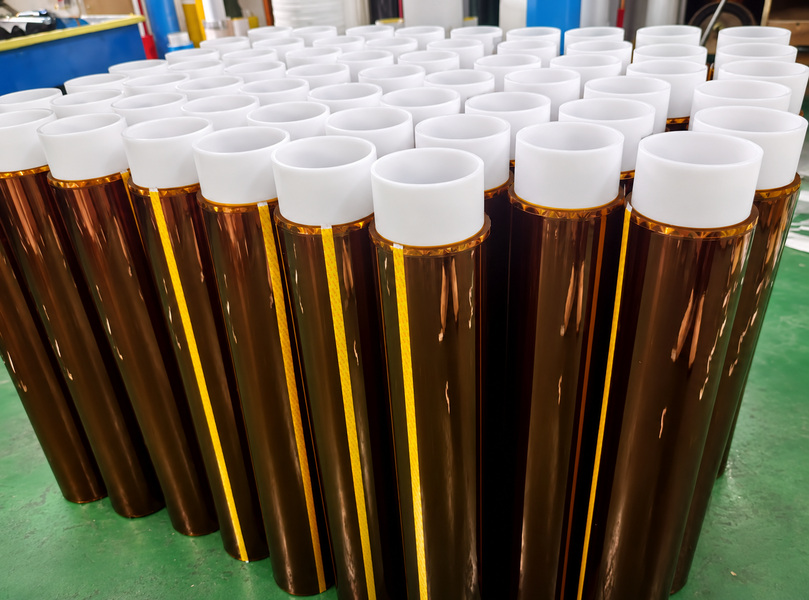
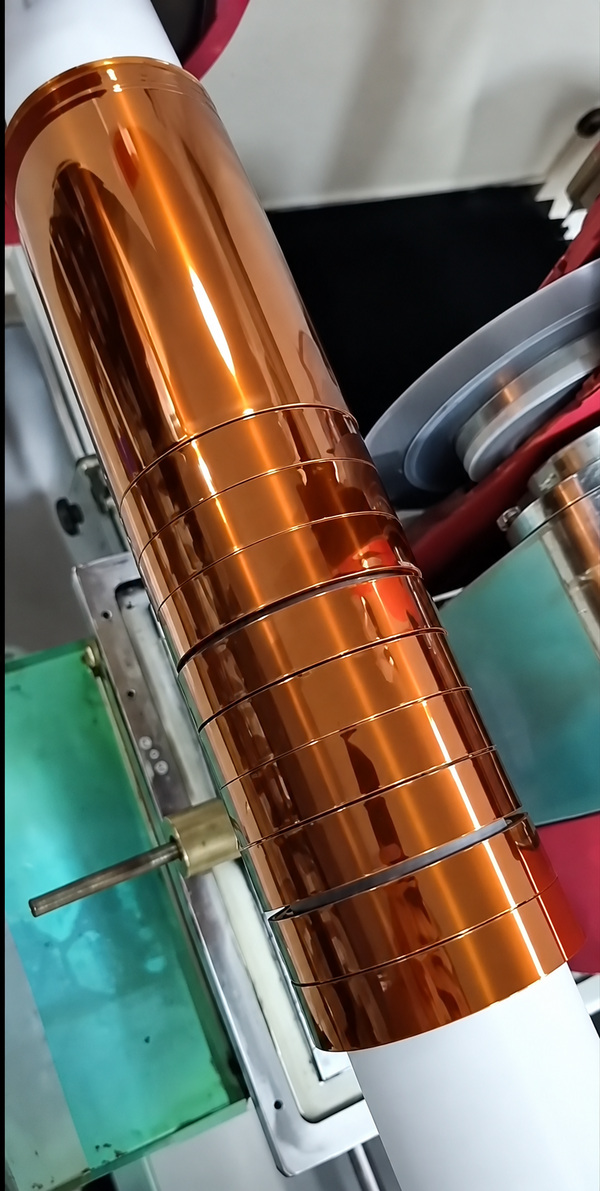
- In-house testing laboratory
- QC department
- Incoming material inspection
- In-process control of thickness and adhesion, tested by batch
- Lot traceability
- Technical documentation on request: TDS; SDS where applicable
For our production lines and capabilities, see Factory & Manufacturing.
Tools and Downloads
- Download TDS (PDF)
- View all datasheets
- Tape unit converter
- All tape tools
- Buying guides
- Comparison articles
- Troubleshooting
Frequently Asked Questions
What is acrylic polyimide tape used for?
K-610 is used for lithium-ion battery tab protection and for coil and lead wrapping in motors and transformers. Neither its adhesive nor its film back contains silicone. Its 311°F (155°C) rating is a 30-minute oven test, so check your process peaks, and for tape that stays in service, your operating temperature and aging requirements.
What temperature can K-610 withstand?
311°F (155°C) for 30 minutes, from a laboratory oven test. This is a short-term rating, not a continuous or long-term service temperature, and not an insulation class. If your peak temperature is higher but within 500°F (260°C), each exposure stays within 30 minutes and silicone is allowed, see Silicone Polyimide Tape K-620. For longer, repeated or continuous exposure, or if silicone is not allowed, send us your temperature profile.
Acrylic or silicone adhesive polyimide tape — which should I choose?
Choose by the process. Silicone adhesive handles higher temperatures and is the usual choice for wave solder and reflow masking. Acrylic adhesive is chosen when the process does not allow silicone, as in battery cells and surfaces that will be coated or bonded.
Can K-610 be used for wave solder, reflow or gold finger masking?
No. K-610 is not rated or tested for soldering temperatures. If silicone adhesive is acceptable and each exposure stays within 500°F (260°C) for no more than 30 minutes, see Silicone Polyimide Tape K-620, which is used for wave solder masking; validate it on your own boards and solder profile.
Is K-610 silicone-free?
Yes. K-610 uses a non-silicone acrylic adhesive, and the back of the film has no silicone coating. If your process is silicone-sensitive, check the other materials that contact the part as well.
Is K-610 suitable for lithium-ion battery tabs, and does it resist electrolyte?
We supply K-610 for lithium-ion battery tab protection. Electrolyte formulations differ, so validate adhesion and lifting in your own electrolyte before production. K-610-055 is the recommended starting grade for battery tabs.
Can K-610 be used as an alternative to 3M 1205?
Customers looking for an alternative to 3M acrylic polyimide tape have ordered K-610. 3M 1205 is named here as a comparison reference: like K-610, it is an amber polyimide film tape with an acrylic pressure-sensitive adhesive. The differences matter in electrical designs. 3M publishes UL Component Recognition for 1205 as a flame-retardant tape under UL 510A, and a continuous operating rating under its UL listing. K-610 has no UL or CSA recognition, its data sheet lists no flame-retardancy rating, and its 311°F (155°C) value is a 30-minute oven test, not a continuous rating. K-610’s own values are in the grade tables above. If your drawing or specification calls for a UL-recognized tape, tell us before ordering, and test K-610 on your own process before switching.
Does K-610 come in die-cut parts or other colors?
No. K-610 is supplied as rolls slit to your width, or as log rolls, in amber only.
What is the shelf life of K-610?
12 months from the date of manufacture when stored in the original packaging in a cool, dry place away from direct sunlight and moisture. Service life once applied depends on your process and conditions.
What are the MOQ and lead time, and can I get a sample?
The minimum order is 10,764 ft² (1,000 m²) per thickness grade. Lead time is 7–15 days of production time from receipt of payment. Small sample quantities are free; the customer pays the freight. For a quote, send the grade or application, width, roll length, quantity, substrate, peak temperature and dwell time, and destination. Different widths of the same grade can be combined toward the minimum.
Request a Quote
Send the grade or application, width, roll length, quantity, peak process temperature and dwell time through the quote form below, or email info@rivertape.com. The substrate and destination help us quote faster. If you are not sure which grade fits, describe the application. Estimated annual volume helps but is optional. Use the same form to request free samples in small quantities (freight paid by the customer).
Technical review: Jeremy Lin · Reviewed October 9, 2026
Content updated: October 9, 2026