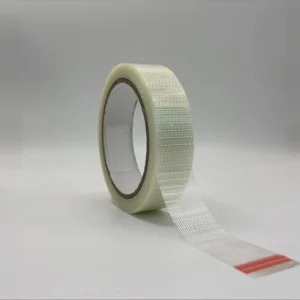
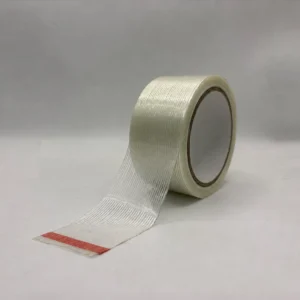
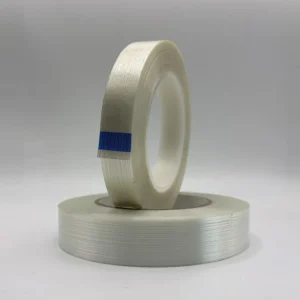
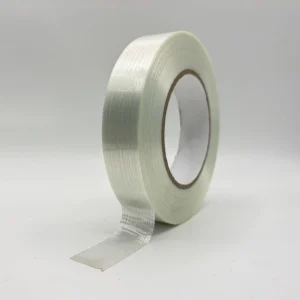
F-370A mono filament strapping tape is a clear, fiberglass reinforced strapping tape that combines a polyester (PET) film backing, continuous unidirectional glass fiber filaments and a solvent-based synthetic rubber pressure-sensitive adhesive (standard) for carton reinforcement and sealing, pallet stabilization, export packing, and pipe, tube and steel bundling. Service temperature: 14 to 158°F (-10 to 70°C).
- Grades: F-370A-11, F-370A-14, F-370A-15
- Total thickness: 4.3–5.9 mil (0.11–0.15 mm)
- Tensile strength: 103–206 lb/in (450–900 N/25 mm)
- Adhesion to steel: 91 oz/in (25 N/25 mm), all grades
- Elongation at break: 6%
- Roll sizes: 3/4 in, 1 in and 2 in wide (approx. 19, 25 and 50 mm), other widths custom slit; approx. 55 yd and 60 yd (50 m and 55 m) long
On This Page
- Construction and Key Features
- Grade Specifications
- Mono, Cross or Clean-Removal Filament Tape?
- Mono Filament, Monofilament and Unidirectional Filament Tape
- Applications by Industry
- Selection and Validation Checklist
- Common Application Problems and Solutions
- Ordering, MOQ and Lead Time
- Converting and Customization
- Manufacturing and Quality Control
- Tools and Downloads
- Frequently Asked Questions
- Request a Quote
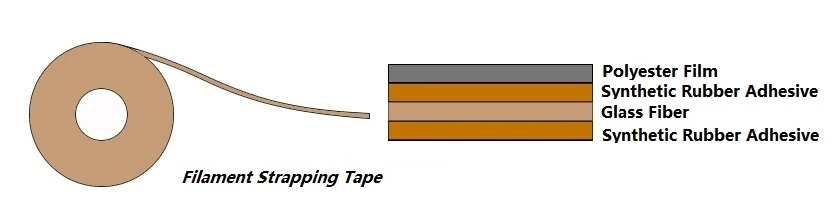
Construction and Key Features
Backing: Polyester (PET) film.
Reinforcement: Continuous glass fiber filaments, unidirectional (lengthwise).
Adhesive: Solvent-based synthetic rubber pressure-sensitive adhesive (standard); hot-melt adhesive available on request. Values on this page were measured with the standard solvent-based synthetic rubber adhesive.
Grade Specifications
Typical values from our laboratory testing; not to be considered specifications. Final performance should be validated under the actual substrate, load condition, application pressure and transport environment. See the TDS for the complete data sheet.
| Grade | Total Thickness | Tensile Strength | Adhesion to Steel | Elongation at Break | Service Temperature |
|---|---|---|---|---|---|
| F-370A-11 | 4.3 mil (0.11 mm) | 103 lb/in (450 N/25 mm) | 91 oz/in (25 N/25 mm) | 6% | 14 to 158°F (-10 to 70°C) |
| F-370A-14 | 5.5 mil (0.14 mm) | 137 lb/in (600 N/25 mm) | 91 oz/in (25 N/25 mm) | 6% | 14 to 158°F (-10 to 70°C) |
| F-370A-15 | 5.9 mil (0.15 mm) | 206 lb/in (900 N/25 mm) | 91 oz/in (25 N/25 mm) | 6% | 14 to 158°F (-10 to 70°C) |
- US customary values are converted from the metric values on the TDS.
- Values were measured with the standard solvent-based synthetic rubber adhesive. Values for the hot-melt version are not covered by this table.
- Tensile strength is a property of the tape, not an allowable load for a taped or bundled package.
For unit conversions, use the Tape unit converter.
Mono, Cross or Clean-Removal Filament Tape?
| Property | F-370A Mono Filament Strapping Tape (this product) | Cross Filament Tape F-370 | Clean-Removal Mono Filament Tape F-370B |
|---|---|---|---|
| Reinforcement | Glass fiber filaments running lengthwise only | Glass fiber filaments woven in two directions, along the length and across the width | Fiberglass yarns running lengthwise only |
| Backing and adhesive | PET film; solvent-based synthetic rubber adhesive (hot-melt available) | PET film; synthetic rubber adhesive | PET film; adhesive developed for removal from appliance surfaces |
| Total thickness | 4.3–5.9 mil (0.11–0.15 mm), three grades | 5.5 mil (0.14 mm) | 6.1 mil (0.155 mm) |
| Tensile strength | 103–206 lb/in (450–900 N/25 mm) | 137 lb/in (600 N/25 mm) | 206 lb/in (900 N/25 mm) |
| Adhesion to steel | 91 oz/in (25 N/25 mm) | 73 oz/in (20 N/25 mm) | 48 oz/in (13 N/25 mm) |
| Main jobs | Carton reinforcement and sealing, pipe and tube bundling, pallet stabilization, steel bundling and securing | Palletizing, bundling and heavy carton reinforcement where loads also act across the tape width | Temporarily holding appliance doors, shelves, racks and drawers during assembly, storage and transport |
| Choose it when | The main load runs along the tape length | Side loads or edge tearing remain after edges are protected; validate on the actual package | The tape must come off finished appliance surfaces; removal must be confirmed on the actual surface, dwell time and temperature history |
F-370 and F-370B values are from their own data sheets; see each product page.
For two-direction reinforcement, see Cross Filament Tape F-370. For temporary securing on finished appliance surfaces, see Clean-Removal Filament Tape F-370B. For a failure-mode guide to choosing between mono and cross, see Mono vs Cross Filament Tape: How to Choose by Packaging Failure Mode. To browse the full range, see all filament tape products.
Not for Electrical Insulation
F-370A is a packaging and bundling tape and is not intended for electrical insulation. For filament-reinforced insulation tape, see Standard Filament-Reinforced Electrical Tape and High-Strength Filament-Reinforced Electrical Tape. For why packaging filament tape should not be used as insulation, see Filament Strapping Tape vs Electrical Filament Tape.
Mono Filament, Monofilament and Unidirectional Filament Tape
Mono filament tape, monofilament tape and unidirectional filament tape describe the same construction: glass fiber filaments laid in one direction, along the length of the tape. Filament tape is one type of strapping tape; some strapping tapes are tensilized polypropylene without glass filaments, so check the reinforcement and construction when comparing products. In F-370A, polyester (PET) is the backing film and glass fiber is the reinforcement, so it is a PET-backed fiberglass filament tape rather than a tape reinforced with polyester filaments. It is also different from fiberglass mesh tape used on drywall joints, and from filament-reinforced electrical tape, which is made for electrical insulation. Buyers may also see this type of product listed as reinforced strapping tape or fiberglass reinforced tape. For an overview of filament tape types and uses, see What Is Filament Tape?; for how it compares with other packaging tapes, see Filament Tape vs Strapping Tape vs Packing Tape.
Applications by Industry
| Industry | Application | Why This Tape | Recommended Grade |
|---|---|---|---|
| Corrugated packaging | Carton reinforcement and sealing | Lengthwise glass filament reinforcement on a PET backing; typical tensile strength 103 lb/in (450 N/25 mm) with 6% elongation at break. | F-370A-11 |
| Pipe and tube manufacturing | Pipe and tube bundling | Unidirectional glass filaments carry tension along the wrap, with 6% typical elongation at break. Check edge contact and protection before production use. | F-370A-11 |
| Warehousing and logistics | Pallet stabilization | F-370A-15 has the highest typical tensile strength in the series, 206 lb/in (900 N/25 mm); F-370A-14 provides 137 lb/in (600 N/25 mm). | F-370A-15; F-370A-14 for lighter loads |
| Steel products | Steel bundling and securing | Typical tensile strength 206 lb/in (900 N/25 mm) with 6% elongation at break. Check edge contact and protection; where side loads or edge tearing remain, evaluate Cross Filament Tape F-370. | F-370A-15 |
For load and packaging guidance, see Carton & Pallet Reinforcement Solutions and Industrial Material Bundling. For pallet loads, see Filament Tape for Pallet Stabilization; for export shipments, see Filament Tape for Export Packaging.
Selection and Validation Checklist
Published values are typical values. Before approving F-370A for production, verify the following on your own packages and equipment.
| What to Verify | Why It Matters | How to Check |
|---|---|---|
| Carton board and surface | Adhesion to steel is 91 oz/in (25 N/25 mm); recycled corrugated board and coated surfaces behave differently. | Apply the tape to the actual cartons and check the bond after packing and handling. |
| Load, wrap pattern and load direction | Mono filament tape carries load mainly along its length, and tensile strength is not an allowable package load. | Test the wrap pattern on the actual package or bundle. Where side loads or edge tearing occur, check edge protection first, then evaluate Cross Filament Tape F-370. |
| Application method and core | F-370A is supplied on 3 in (76 mm) plastic cores. | Confirm the cutting method, tape width and core fit for manual application, hand dispensers or automatic equipment. |
| Temperature | Service temperature is 14 to 158°F (-10 to 70°C). The TDS does not state an application temperature range. | If tape will be applied or used outside normal indoor conditions, trial it under those conditions before production use. |
For the full list of data to request before an RFQ, see the Filament Tape Specification Checklist.
For background on specifications for filament-reinforced packaging tape, see ASTM D5330/D5330M. This reference is general background and does not mean F-370A has been tested or certified to that specification.
Common Application Problems and Solutions
These are common issues when applying filament tape to cartons and bundles, with practical checks. They describe possible application issues, not recorded F-370A failures.
| Problem | Likely Cause | Solution | Further Reading |
|---|---|---|---|
| Carton seams, edges or hand holes split in transit | Stress concentrates at seams, edges, corners and hand holes rather than across the whole box | Reinforce the specific weak points and test the packed carton through handling and stacking | Reinforce corrugated boxes with filament tape |
| Bundling tape breaks | The load is more than the tape and wrap pattern can carry | Review the wrap pattern and number of wraps, consider a higher-tensile grade, and validate on the actual bundle | Mono or cross filament tape for pipe bundles |
| Tape cut or torn at an edge | Sharp edges in contact with the tape | Add edge protection first; if side loads or edge tearing remain, evaluate Cross Filament Tape F-370 | Mono or cross filament tape for pipe bundles |
| Tape intact but the bundle loosens | Low or uneven wrap tension, bundle settling, or a dusty or oily surface | Apply under consistent tension to clean, dry surfaces and recheck after handling | Mono or cross filament tape for pipe bundles |
| Residue after removal from finished surfaces | The tape is not designed for removal from that surface | Evaluate Clean-Removal Filament Tape F-370B on the actual surface | — |
| Tape delaminates, edges fray or the roll is hard to unwind | Roll damage such as crushed sides, storage conditions, or the cutting blade or dispenser setup | Inspect the roll and hand-unwind it to separate tape issues from equipment issues; check storage and the blade or dispenser, and compare with a known-good roll | Filament tape delamination, fraying and difficult unwind |
Ordering, MOQ and Lead Time
| Ordering Detail | Value |
|---|---|
| Width | Common widths 3/4 in, 1 in and 2 in (approx. 19, 25 and 50 mm); other widths custom slit to order; log rolls approx. 40 in (1,020 mm) |
| Roll lengths | Approx. 55 yd and 60 yd (50 m and 55 m); supplied in metric lengths |
| Core inner diameter | 3 in (76 mm) |
| Core material | Plastic |
| MOQ | 10,764 ft² (1,000 m²) |
| Lead time | 7–14 days (production time) |
| Sample policy | Free samples; freight paid by the customer |
| Shelf life | 12 months from date of manufacture |
| Storage conditions | In the original packaging in a cool, dry place away from direct sunlight and moisture |
Minimum order is measured by tape area. For example, at 1 in (25.4 mm) width the minimum is at least 788 rolls of 50 m or 716 rolls of 55 m. Send your width and roll length and we will confirm the roll count for your specification.
Lead time is production time, excluding transit. EXW, FOB and CIF are all available; trade terms are not fixed.
For volume and distributor supply of filament strapping tape, see our filament strapping tape supplier page.
Converting and Customization
- Slitting to width
- Log / jumbo rolls
- Logo or label printing
- OEM packaging and private label
Manufacturing and Quality Control
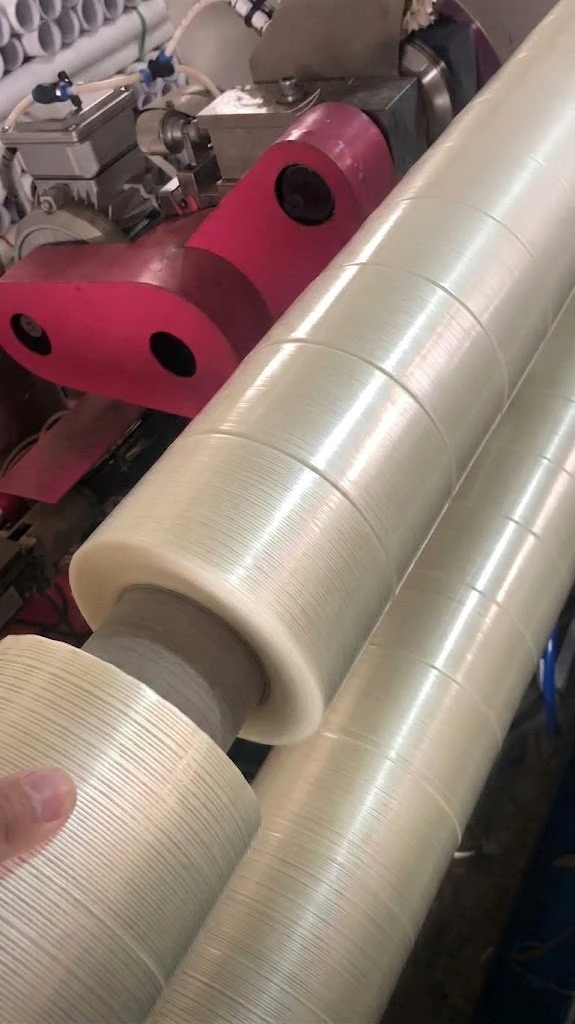
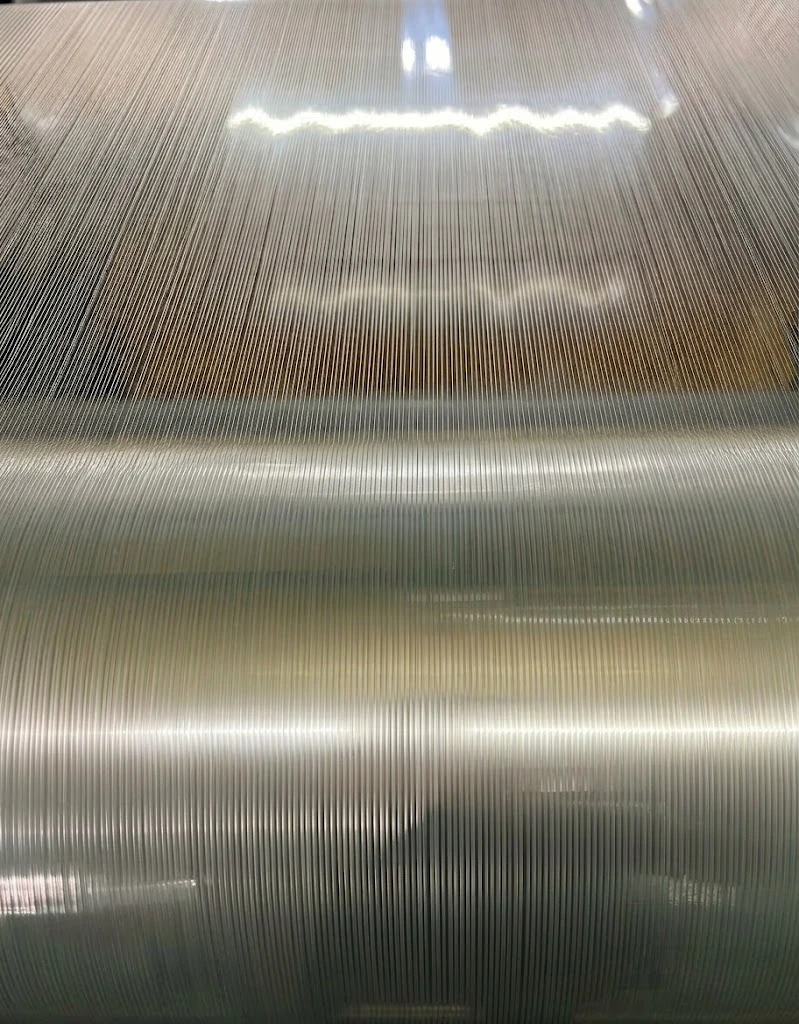
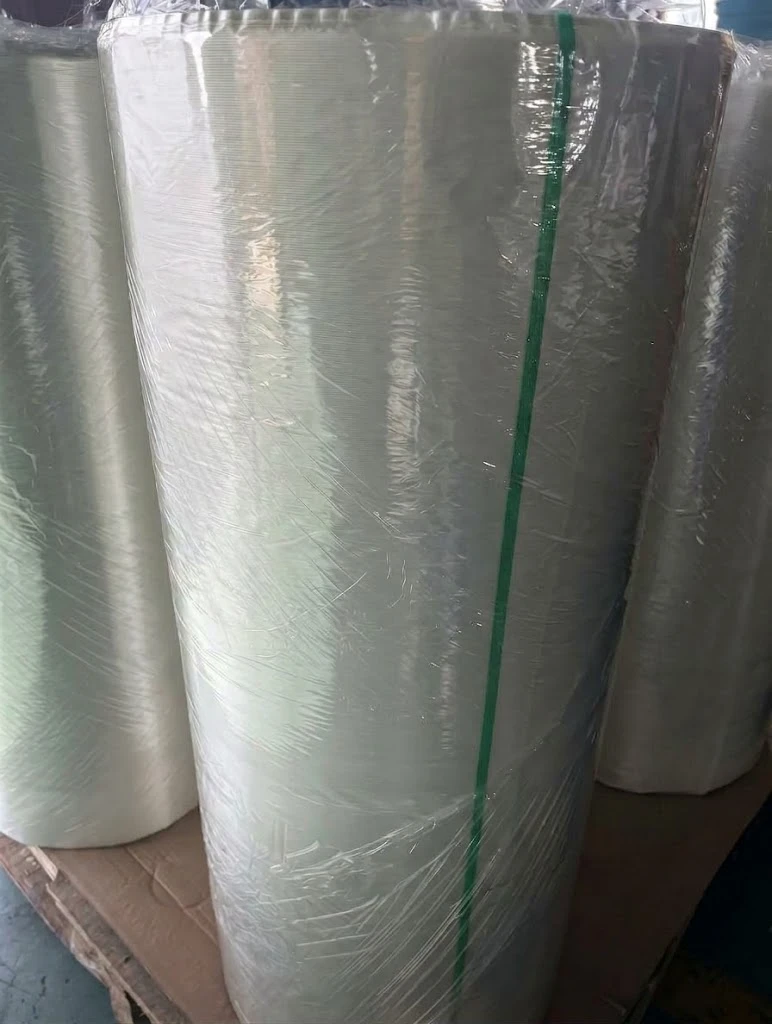

- In-house testing laboratory
- QC department
- Incoming material inspection
- In-process control of thickness and adhesion, tested by batch
- Lot traceability
- Technical documentation on request: TDS, and SDS where applicable
For our production lines and capabilities, see Factory & Manufacturing.
Tools and Downloads
- Download TDS (PDF)
- View all datasheets
- Tape unit converter
- All tape tools
- Buying guides
- Comparison articles
- Troubleshooting
Frequently Asked Questions
What is mono filament strapping tape used for?
F-370A is used for carton reinforcement and sealing, pipe and tube bundling, pallet stabilization, export packing, and steel bundling and securing. The applications table lists recommended grades for carton reinforcement, pipe and tube bundling, pallet stabilization and steel bundling.
Is filament tape the same as strapping tape?
Filament tape is one type of strapping tape. Some strapping tapes are tensilized polypropylene without glass filaments. F-370A is reinforced with continuous glass fiber filaments running along the tape length.
How is it different from regular packing tape?
Standard BOPP carton sealing tape has no reinforcement and is mainly used to close cartons. F-370A adds continuous glass fiber filaments to a PET backing, with typical tensile strength of 103–206 lb/in (450–900 N/25 mm) depending on grade, for reinforcing cartons and bundling materials. If the carton only needs closing, standard sealing tape may be enough.
Which F-370A grade should I choose?
Start with F-370A-11 for carton reinforcement, sealing and pipe bundling. F-370A-15, the highest-tensile grade, is used for pallet stabilization and steel bundling; F-370A-14 sits between them and is used for lighter pallet loads. All three grades share the same adhesion to steel, elongation at break and service temperature. Confirm the grade with samples on your own packages.
Can filament tape replace plastic strapping?
It depends on the load and the application. F-370A’s tensile values are tape properties, not allowable loads for a strapped package, so they cannot show on their own whether the tape can replace strapping. Test the tape on your actual loads and handling conditions before making the change.
Is a hot-melt adhesive version available?
Yes. The standard adhesive is a solvent-based synthetic rubber, and a hot-melt version is available on request. The values on this page and on the TDS were measured with the standard solvent-based adhesive.
Mono or cross filament tape — which do I need?
Mono filament tape is reinforced in one direction, along its length. Cross filament tape such as F-370 is reinforced in two directions. Where the job involves side loads or edge tearing, check edge protection first, then evaluate F-370. See the comparison above.
Can F-370A be used for electrical insulation?
No. F-370A is a packaging and bundling tape. For electrical insulation, see Standard Filament-Reinforced Electrical Tape and High-Strength Filament-Reinforced Electrical Tape.
How is the MOQ calculated?
Minimum order is 10,764 ft² (1,000 m²) of tape area. At 1 in (25.4 mm) width, that is at least 788 rolls of 50 m or 716 rolls of 55 m.
Can I get a sample before ordering?
Yes. Samples are free; the customer pays the freight. Send the grade, width and application through the quote form or to info@rivertape.com.
Request a Quote
Send your required width, roll length, operating temperature and estimated annual volume through the quote form below, or email info@rivertape.com.