


F-390 is a PET fiberglass cloth tape: polyester film bonded to fiberglass cloth with an acrylic adhesive layer, coated with an acrylic pressure-sensitive adhesive. It is used to hold down magnet wire, copper strips and insulation materials during coil winding in dry-type transformers, motors and generators, and for lead anchoring and banding of coils. Temperature rating: 311°F (155°C) continuous.
- Total thickness: 6.3 mil (0.16 mm)
- Tensile strength: 274 lbf/in (1200 N/25 mm)
- Elongation at break: 5%
- Adhesion to steel: 32.9 oz/in (9 N/25 mm)
- Dielectric breakdown voltage: 5.5 kV
- White; 164 ft (50 m) and 180 ft (55 m) rolls, slit to width
On This Page
- Construction and Key Features
- Grade Specifications
- F-390 and 3M™ 1039: Published Data Side by Side
- PET Fiberglass Cloth Tape, Polyester Glass Tape and Related Terms
- Applications by Industry
- Selection and Validation Checklist
- Common Application Problems and Solutions
- Ordering, MOQ and Lead Time
- Converting and Customization
- Manufacturing and Quality Control
- Tools and Downloads
- Frequently Asked Questions
- Request a Quote
Construction and Key Features
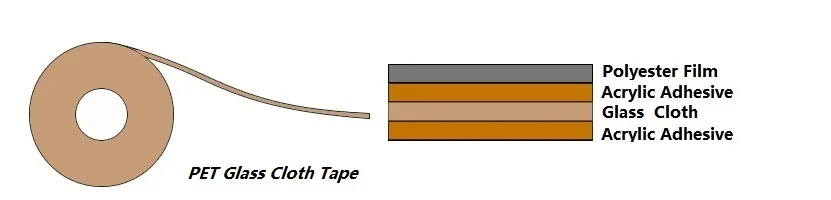
PET film backing. The top layer is polyester (PET) film, which provides the tape’s dielectric strength.
Acrylic bonding layer. An acrylic adhesive layer bonds the PET film to the fiberglass cloth.
Fiberglass cloth reinforcement. The fiberglass cloth provides tensile strength and low elongation: typical tensile strength is 274 lbf/in (1200 N/25 mm) with 5% elongation at break.
Acrylic pressure-sensitive adhesive. The bottom layer is an acrylic pressure-sensitive adhesive with typical adhesion to steel of 32.9 oz/in (9 N/25 mm).
Grade Specifications
Values below are typical values from our laboratory testing, for reference only; they are not product specifications. See the F-390 technical data sheet (PDF).
| Property | F-390 Typical Value |
|---|---|
| Backing material | Polyester film |
| Reinforcement | Fiberglass cloth |
| Adhesive | Acrylic |
| Color | White |
| Total thickness | 6.3 mil (0.16 mm) |
| Tensile strength | 274 lbf/in (1200 N/25 mm) |
| Elongation at break | 5% |
| Adhesion to steel | 32.9 oz/in (9 N/25 mm) |
| Dielectric breakdown | 5.5 kV |
| Temperature rating | 311°F (155°C) continuous |
- Actual performance should be verified with your conductors, insulating materials, winding process, insulation system and end-use conditions.
- US customary values are converted from the metric values on the TDS.
Need to convert units? Use our tape unit converter.
F-390 and 3M™ 1039: Published Data Side by Side
The table compares selected published properties of F-390 and 3M 1039, including differences relevant to qualification. These data do not establish interchangeability in a particular insulation system.
| Property | F-390 | 3M™ 1039 (published) |
|---|---|---|
| Construction | PET film bonded to fiberglass cloth with acrylic adhesive | Polyester film / glass filament scrim (2012 data sheet); the product page also describes woven glass-mat reinforcement |
| Adhesive | Acrylic | Thermosetting acrylic, pressure-sensitive |
| Total thickness | 6.3 mil (0.16 mm) | 7.0 mil (0.177 mm) |
| Tensile strength | 274 lbf/in (1200 N/25 mm) | 275 lb/in (481 N/10 mm) |
| Elongation at break | 5% | 5% |
| Adhesion to steel | 32.9 oz/in (9 N/25 mm) | 35 oz/in (3.81 N/10 mm) |
| Dielectric breakdown | 5.5 kV | 5,500 V |
| Insulation resistance | — | 1×10⁵ megohms |
| Temperature rating | 311°F (155°C) continuous | -40°F to 266°F (-40°C to 130°C) |
| Back-side coating for controlled unwind | — | Yes (2012 data sheet) |
| Bonding to diamond paper / epoxy during baking | Not validated | Stated on the 3M product page |
| UL | None | UL Recognized Component per the 2012 data sheet; the product page states “UL Listed” |
| Shelf life | 12 months from manufacture | 5 years from manufacture |
| Standard roll length | 164 ft (50 m) or 180 ft (55 m) | 60 yd (54.9 m) |
Numerical properties, shelf life and roll length for 3M 1039 are quoted from the February 2012 3M data sheet; additional construction and baking-bond information comes from the official 3M product page. The two sources use different UL wording; check current approval details for the product supplied. Values from different data sheets may be measured by different methods.
3M is a trademark of 3M Company. The 1039 product designation is used for identification and comparison only. River Tape is not affiliated with or endorsed by 3M Company.
If your drawing or approval requires a UL-recognized tape, F-390 is not suitable. For a glass-filament construction instead of fiberglass cloth, see our Standard Filament-Reinforced Electrical Tape and High-Strength Filament-Reinforced Electrical Tape.
PET Fiberglass Cloth Tape, Polyester Glass Tape and Related Terms
PET is polyethylene terephthalate, the polyester film used as the backing of this tape, so “PET fiberglass cloth tape” and “polyester glass tape” both describe a polyester film tape reinforced with glass. In F-390 the glass is a fiberglass cloth. Filament-reinforced tapes use glass yarns or a filament scrim instead. Glass cloth tape uses glass fabric as the backing without a polyester film layer. Class F denotes thermal class 155, corresponding to 311°F (155°C). A tape’s material temperature rating does not by itself establish the thermal class or approval of an assembled insulation system.
Applications by Industry
| Industry | Application | Why This Tape | Recommended Grade |
|---|---|---|---|
| Dry-type transformers | Holding down magnet wire, copper strips (sheets) and insulation materials during coil winding | Fiberglass-cloth reinforcement; typical tensile strength 274 lbf/in (1200 N/25 mm) and 5% elongation at break | F-390 |
| Dry-type transformers | Lead anchoring and lead tape anchoring | Fiberglass-cloth reinforcement with acrylic pressure-sensitive adhesive | F-390 |
| Transformers and motors | Banding of coils | Fiberglass-cloth reinforcement; 5% elongation at break | F-390 |
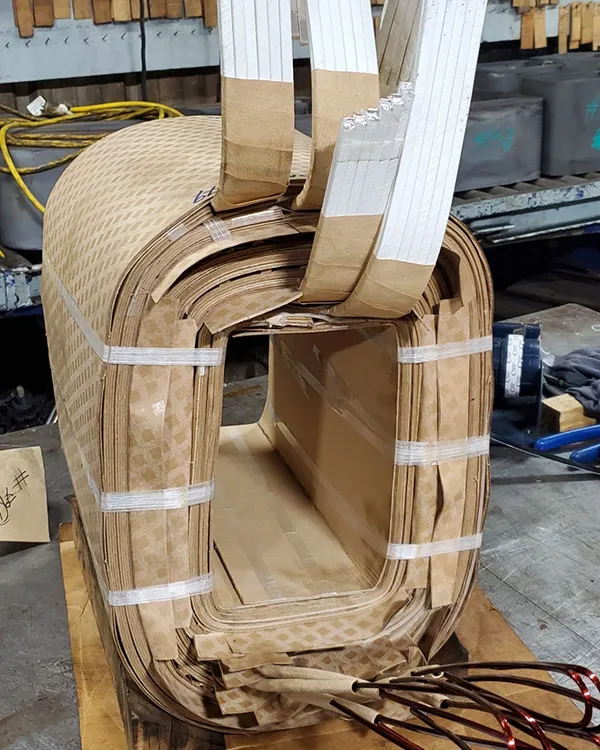
| Electric motors | Motor winding: holding down and banding coils | Polyester film for dielectric strength, fiberglass cloth for tensile strength | F-390 |
| Generators | Generator coil winding | PET film and fiberglass cloth construction; rated 311°F (155°C) continuous | F-390 |
| Dry-type transformers | Low-voltage foil windings: fixing the start and finish of copper or aluminum foil and holding interlayer insulation | Fiberglass-cloth reinforcement for holding foil ends and interlayer insulation during winding | F-390 |
| Dry-type transformers | High-voltage layer or disc windings: holding magnet wire, rectangular wire and layer insulation paper | Typical tensile strength 274 lbf/in (1200 N/25 mm) | F-390 |
| Dry-type transformers | Securing lead-outs and tap leads to the coil body | Fiberglass-cloth reinforcement with acrylic adhesive | F-390 |
| Dry-type transformers | Banding cooling-duct spacers on formed coils | Fiberglass-cloth reinforcement; confirm spacer positioning after your winding and thermal process | F-390 |
| Transformers and motors | Crossover insulation and coil cover wrapping | Polyester film dielectric layer; 5.5 kV typical dielectric breakdown | F-390 |
Related products and resources: Motor & Transformer Insulation · Standard Filament-Reinforced Electrical Tape · High-Strength Filament-Reinforced Electrical Tape · G-430 Glass Cloth Tape
Selection and Validation Checklist
F-390 values are published typical values. Before approving the tape for production, verify the points below on your own coils and process.
| What to Verify | Why It Matters | How to Check |
|---|---|---|
| Compatibility with your dip-and-bake or VPI process | Adhesion and residue after resin impregnation and curing have not been validated for F-390 | Run a trial coil through your actual varnish or VPI and cure cycle; check for lifting, flagging and residue after cure |
| Thermal class of your insulation system | F-390’s 311°F (155°C) continuous rating is a material rating; it does not establish the thermal class or approval of an assembled insulation system, and F-390 carries no UL recognition | Confirm the system’s evaluation and component requirements. For background on thermal classes, see IEC 60085. |
| Adhesion on your actual substrates | Adhesion to steel is 32.9 oz/in (9 N/25 mm); enamelled wire, insulation paper and copper or aluminum foil behave differently | Apply at production winding tension and inspect after winding and after cure |
| Dielectric requirement | 5.5 kV is the published typical dielectric breakdown value, not an operating-voltage or insulation-system design rating | Verify the actual insulation build against the design requirement |
Common Application Problems and Solutions
Use the checks below when qualifying glass-reinforced polyester tape for coil winding. They describe possible application issues, not recorded F-390 failures; corrective changes should be verified on the actual assembly.
| Problem | Likely Cause | Solution | Further Reading |
|---|---|---|---|
| Tape end lifts or flags after winding | The stiff film-and-glass backing springs back on tight radii and corners; tape end cut too short; too little rub-down; lubricant or dust on wire or foil | Check surface cleanliness, application pressure, overlap and tape-end position. Trial changes to width or wrapping geometry only where they preserve the required coverage, contact area and mechanical support | Glass cloth tape troubleshooting |
| Leads or tap leads move after heating or resin cure | The heat cycle changes adhesive behavior and the lead and coil expand differently; short anchoring length; lead under bending load | Check lead movement before and after the actual cure cycle. Review anchoring area, wrap geometry and mechanical support; validate any change in anchoring length or number of wraps against the coil design | Why tape slips on transformer leads after heating |
| Residue, lifting or adhesion loss after dip-and-bake or VPI | Interaction between impregnating resin or solvent and the adhesive; cure temperature or time beyond what was tested | Run a trial coil through the full impregnation and cure cycle before approval. Record the actual part temperature, dwell time and resin system, then inspect adhesion, lifting and lead position after processing and cooling | Glass cloth tape troubleshooting |
| Coil results change after switching from a previously approved tape | Differences in reinforcement, thickness, back-side treatment and unwind force can change coil build, machine handling and bonding to layer insulation during baking | Wind trial coils on the production machine; check coil dimensions, unwind behavior and bonding to layer insulation after baking; re-evaluate insulation-system approvals that list specific components. Small samples are available free of charge; the buyer pays the freight | — |
| Tape selected for an oil-filled transformer | A tape used in dry-type windings is not necessarily compatible with transformer oil; tape materials can affect oil condition as they age | F-390 has not been tested in transformer oil and is offered for dry-type transformer, motor and generator coil applications. For oil-filled units, choose a tape with oil compatibility data for your transformer fluid | Dry-type and oil-filled processes |
Ordering, MOQ and Lead Time
| Item | Details |
|---|---|
| Width | Log rolls 39.4–40.2 in (1,000–1,020 mm); slit widths to customer requirement |
| Roll length | 164 ft (50 m) and 180 ft (55 m) |
| Core inner diameter | 3 in (76 mm) |
| Core material | Usually plastic |
| MOQ | 10,764 ft² (1,000 m²) |
| Lead time | 7–15 days |
| Samples | Small samples are available free of charge; the buyer pays the freight. |
| Shelf life | 12 months from the date of manufacture |
| Storage | In original packaging at 50–80.6°F (10–27°C) and below 75% relative humidity, away from direct sunlight and heat sources |
MOQ is based on total tape area (width × roll length × number of rolls). For example, 1 in (25.4 mm) wide rolls need at least 788 rolls of 164 ft (50 m) or 716 rolls of 180 ft (55 m). Calculations use the metric order dimensions.
Lead time is production time and does not include transit. Trade terms are flexible: EXW, FOB and CIF are all available.
Converting and Customization
- Slitting to width
- Log and jumbo rolls
- Logo and label printing
- OEM packaging and private label
Manufacturing and Quality Control
- In-house testing laboratory
- Dedicated QC department
- Incoming material inspection
- Lot traceability
Tools and Downloads
- Download F-390 TDS (PDF)
- View all datasheets
- Tape unit converter
- All tape tools
- Buying guides
- Comparison articles
- Troubleshooting
Frequently Asked Questions
Can F-390 be used as an alternative to 3M 1039?
F-390 can be evaluated as an alternative, but the two tapes are not identical. F-390 has a PET film, an acrylic bonding layer, fiberglass cloth and an acrylic pressure-sensitive adhesive, and is rated 311°F (155°C) continuous. It has no UL recognition and a 12-month shelf life, and bonding to diamond paper or epoxy during baking has not been validated. If you are looking for a 3M 1039 equivalent, compare the published data in the table above and validate F-390 in your own process. Small samples are available free of charge; the buyer pays the freight.
3M is a trademark of 3M Company. The 1039 product designation is used for identification and comparison only. River Tape is not affiliated with or endorsed by 3M Company.
What does Class F mean for F-390?
Class F denotes thermal class 155, corresponding to 311°F (155°C). F-390 is rated 311°F (155°C) continuous as a material. This rating does not establish the thermal class or approval of an assembled insulation system, and F-390 holds no UL recognition.
What is PET fiberglass cloth tape used for?
It combines polyester film, which provides dielectric strength, with fiberglass cloth, which provides tensile strength and low elongation. F-390 is used in dry-type transformer, motor and generator coil production to hold down magnet wire, copper strips and insulation materials during winding, and for lead anchoring and banding of coils.
Is F-390 UL listed or certified?
No. F-390 holds no UL recognition or other certification. If your design or approval requires a certified component, F-390 is not suitable.
Is F-390 compatible with VPI or dip-and-bake processes?
This has not been validated. Run a trial coil through your actual impregnation and cure cycle and check adhesion and residue before approving the tape for production.
Can F-390 be used in oil-filled transformers?
No. F-390 has not been tested in transformer oil. It is offered for dry-type transformer, motor and generator coil applications. For oil-filled units, choose a tape with oil compatibility data for your transformer fluid.
How is the MOQ calculated?
MOQ is 10,764 ft² (1,000 m²) of total tape area (width × roll length × number of rolls). For example, 1 in (25.4 mm) wide rolls need at least 788 rolls of 164 ft (50 m).
Can I get a sample before ordering?
Yes. Small samples are available free of charge; the buyer pays the freight. Tell us the width you need and your application through the quote form or at info@rivertape.com.
Request a Quote
Send your required width, roll length, operating temperature and estimated annual volume through the quote form at the top of this page, or email info@rivertape.com.
Technical review: Jeremy Lin · Reviewed September 27, 2026
Content updated: September 29, 2026
