


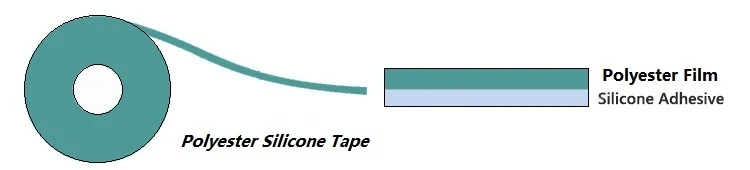
P-350 is a high-temperature PET silicone adhesive tape for powder coating masking: green polyester (PET) film with silicone adhesive, rated 392 °F (200 °C) for 30 minutes in our in-house oven test. It comes in three thicknesses, slit to the width your line uses.
- Green PET film with silicone adhesive; single-sided, no liner
- Three grades: 2.0 / 2.4 / 3.1 mil (0.05 / 0.06 / 0.08 mm) total thickness
- Temperature resistance: 392 °F (200 °C) for 30 minutes (in-house oven test)
- 180° peel adhesion to steel: 24.9–35.8 oz/in (6.8–9.8 N/25 mm), ASTM D3330
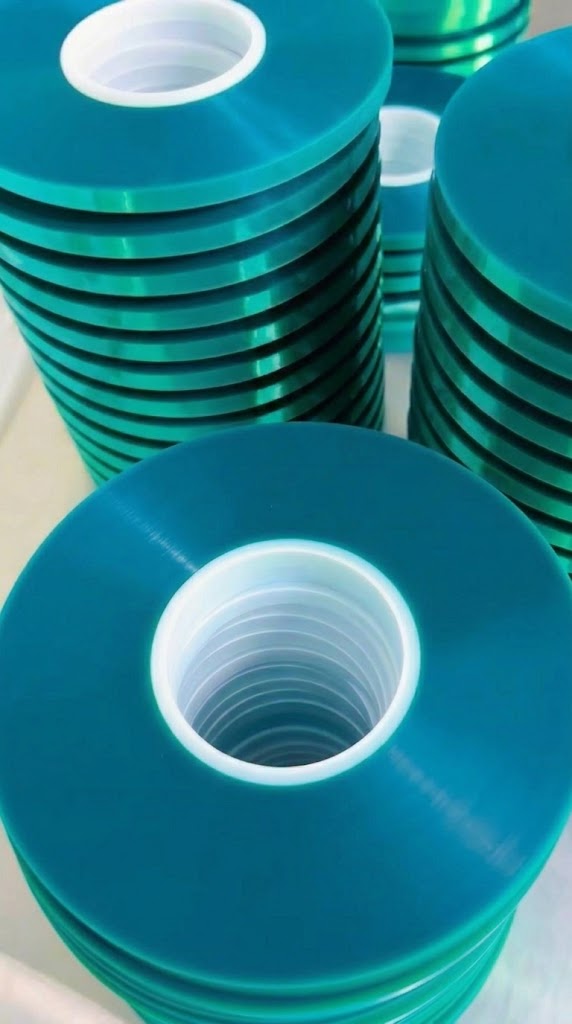
- 72 yd (66 m) or 36 yd (33 m) rolls slit to width; 42.1 in (1070 mm) log rolls also supplied
- MOQ 10,764 ft² (1,000 m²); small sample quantities free, freight paid by the customer
On This Page
- Construction and Key Features
- Grade Specifications
- PET Silicone Tape or Polyimide Tape for Powder Coating?
- How P-350-80 Compares on Published Data
- PET Silicone Tape, Green Polyester Tape and Powder Coating Tape
- Applications by Industry
- Selection and Validation Checklist
- Common Application Problems and Solutions
- Ordering, MOQ and Lead Time
- Converting and Customization
- Manufacturing and Quality Control
- Tools and Downloads
- Frequently Asked Questions
- Request a Quote
Construction and Key Features
Backing: PET (polyester) film — 1.5 mil (0.038 mm) on P-350-50 and P-350-60; 2.4 mil (0.060 mm) on P-350-80 (nominal).
Adhesive: silicone pressure-sensitive adhesive — 0.5 / 0.9 / 0.8 mil (0.012 / 0.022 / 0.020 mm), calculated as total minus backing. Single-sided, supplied without a release liner.
Grade Specifications
Typical values from our laboratory testing; not for specification purposes. See the TDS for the temperature test conditions.
| Property | Test Method | P-350-50 | P-350-60 | P-350-80 |
|---|---|---|---|---|
| Total thickness | ASTM D3652 | 2.0 mil (0.05 mm) | 2.4 mil (0.06 mm) | 3.1 mil (0.08 mm) |
| Backing thickness | Nominal | 1.5 mil (0.038 mm) | 1.5 mil (0.038 mm) | 2.4 mil (0.060 mm) |
| Adhesive thickness | Calculated | 0.5 mil (0.012 mm) | 0.9 mil (0.022 mm) | 0.8 mil (0.020 mm) |
| 180° peel adhesion to steel | ASTM D3330 | 24.9 oz/in (6.8 N/25 mm) | 32.2 oz/in (8.8 N/25 mm) | 35.8 oz/in (9.8 N/25 mm) |
| Tensile strength | ASTM D3759 | 25.1 lb/in (110 N/25 mm) | 41.1 lb/in (180 N/25 mm) | 54.8 lb/in (240 N/25 mm) |
| Elongation at break | ASTM D3759 | ≥60% | ≥80% | ≥100% |
| Temperature resistance (30 min) | In-house oven test | 392 °F (200 °C) | 392 °F (200 °C) | 392 °F (200 °C) |
- Temperature test: tape applied to a steel panel, held at 392 °F (200 °C) for 30 minutes, cooled to room temperature and removed. Pass criteria: no shrinkage, curling or edge lift; one-piece removal with no adhesive residue.
- Adhesive thickness = total thickness minus nominal backing thickness.
- Inch and imperial values are converted from metric and rounded.
Test methods: total thickness — ASTM D3652; 180° peel adhesion — ASTM D3330; tensile strength and elongation — ASTM D3759. Temperature resistance — in-house oven test.
PET Silicone Tape or Polyimide Tape for Powder Coating?
| Factor | P-350 PET Silicone Tape | Silicone Polyimide Tape (K-620) |
|---|---|---|
| Backing / adhesive | PET film / silicone | Polyimide film / silicone |
| Typical fit | Cure cycles within 392 °F (200 °C) for 30 min; flat or large masked areas | Longer or hotter cure cycles, repeated bakes, heavy parts that hold heat longer |
| Choose it when | Part temperature and dwell stay within the P-350 rating | The cure cycle exceeds the P-350 rating, or trials still show shrinkage or edge lift after surface preparation, application and removal have been checked; qualify K-620 against its own data sheet |
If your cure cycle is beyond the P-350 rating, evaluate silicone polyimide tape directly. If P-350 is within its rating but edges lift or the tape tears, check surface preparation, application pressure and removal first; polyester vs polyimide tape for powder coating explains which signs point to the film and which point to the process. For edge-line and residue criteria, see our selection guide for edge lines, residue and heat exposure.
How P-350-80 Compares on Published Data
Customers have asked us about these two green PET/silicone tapes. The table lists each maker’s published values as stated in the cited sources; we make no performance claim beyond our own data.
| Property | River Tape P-350-80 | 3M™ Polyester Tape 8992 | tesa® 50600 |
|---|---|---|---|
| Backing / adhesive | PET / silicone | Polyester / silicone | PET / silicone |
| Total thickness | 3.1 mil (0.08 mm) | 3.2 mil (0.082 mm) | 3.1 mil (0.080 mm) |
| Backing thickness | 2.4 mil (0.060 mm) | 2.0 mil (0.052 mm) | — |
| Peel adhesion to steel | 35.8 oz/in (9.8 N/25 mm) | 43.9 oz/in (12.0 N/25 mm) | 36.5 oz/in (10.0 N/25 mm) |
| Tensile strength | 54.8 lb/in (240 N/25 mm) | 57.0 lb/in (249.5 N/25 mm) | 42.8 lb/in (187.5 N/25 mm) |
| Elongation at break | ≥100% | 148% | 110% |
| Test methods | ASTM D3652; ASTM D3330, 180°; ASTM D3759 | ASTM D3652; ASTM D3330, 180° at 12 in/min (305 mm/min); ASTM D3759 | — |
| Temperature resistance | 392 °F (200 °C), 30 min | Up to 400 °F (204 °C); duration not stated in the cited source | 428 °F (220 °C), 30 min |
| Liner | None | Cited TDS lists a 3.0 mil (0.075 mm) polyester liner; a linered version is offered for die-cuts | Standard version without liner; linered version (PV1) available |
| Standard roll length | 72 / 36 yd (66 / 33 m) | 72 yd (65.8 m) | — |
Sources: 3M Polyester Tape 8992 Technical Data Sheet (English, EU edition, 09/2024) and 3M US product page (checked October 6, 2026) for the temperature value; tesa 50600 product information (03/2024) and tesa powder coating brochure (06/2025) for elongation. Values converted to US units where needed. Each maker uses its own test conditions; qualify any tape on your own parts and cure cycle.
PET Silicone Tape, Green Polyester Tape and Powder Coating Tape
PET is polyethylene terephthalate, the polyester film used as the backing. Buyers use several names for this product family: PET silicone tape, polyester silicone tape, green polyester tape, powder coating tape and powder coating masking tape. Green is an identification color that makes the tape easy to place and to find for removal; it is not a specification. P-350 in blue, transparent or yellow has the same properties. Specify PET film with silicone adhesive, thickness and the temperature/time rating rather than color. See our polyester silicone tape guide.
Applications by Industry
| Industry | Application | Why This Tape | Recommended Grade |
|---|---|---|---|
| Powder coating | Masking areas that must stay uncoated through the cure cycle, within 392 °F (200 °C) for 30 min | Silicone adhesive and PET backing hold through the rated cycle; the green backing is easy to find for removal | P-350-80 for flat or large areas; P-350-50 for contoured parts |
| Automotive | Protecting areas from paint or other chemicals during painting and repair | Removes cleanly after heat exposure | P-350-50 for contoured areas, P-350-80 for flat areas |
| Surface protection | Reducing scratches on finished parts during handling and shipping | PET backing covers the surface and peels off cleanly | P-350-50 for contoured areas, P-350-80 for flat areas |
| Electronics | Masking delicate components during soldering, painting or spraying, within 392 °F (200 °C) for 30 min | Thin film conforms around small components | P-350-50 for contoured areas, P-350-80 for flat areas |
| PCB manufacturing | Masking areas that should not be etched or plated | 1.5 mil (0.038 mm) backing with the heaviest adhesive coat of the three grades | P-350-60 |
| Sign making | Masking selected areas during painting or printing | Thin backing gives a sharp paint edge | P-350-50 for contoured areas, P-350-80 for flat areas |
| Epoxy resin work | Holding and masking during epoxy work; peels off easily | Strongest backing of the three grades | P-350-80 |
Grade rule: the 2.0 mil (0.05 mm) grade follows curves and tight contours; the 3.1 mil (0.08 mm) grade suits flat areas and one-piece removal. Compare grades on your own parts with sample rolls.
Soldering peaks above 392 °F (200 °C) are outside the P-350 rating; see the PCB masking solutions linked below.
For coating applications, see powder coating masking solutions. For electronics masking, see gold finger masking for reflow and wave soldering.
Selection and Validation Checklist
A tape that passes on paper can still fail on the line. Check these four points on real parts before ordering in volume.
| What to Verify | Why It Matters | How to Check |
|---|---|---|
| Part temperature and dwell time in your cure cycle | P-350 is rated 392 °F (200 °C) for 30 min; heavy parts can stay hot longer than the oven setting suggests | Measure part temperature through the cycle and trial the tape on the heaviest part you coat |
| Surface condition before masking | Oil, moisture or pretreatment residue changes how the adhesive bonds and releases | Apply to clean, dry parts with firm pressure; use a roller or squeegee on wide areas |
| Removal timing and method | Clean removal depends on when and how the tape is pulled | On the same part, compare removal while warm and after cooling, and vary angle and speed; check edges, residue and tearing |
| Later painting or bonding on masked areas | Silicone adhesive transfer can cause coating defects on surfaces that are recoated or bonded | Recoat or bond a masked test area before approving any silicone tape for that part |
P-350 is supplied as 42.1 in (1070 mm) log rolls; our PET silicone tape log and jumbo roll buying guide explains roll formats in general.
When you compare datasheets, check which method each value comes from. Peel adhesion of tapes is commonly reported to ASTM D3330, tensile strength and elongation to ASTM D3759, and thickness to ASTM D3652; values measured with different methods are not directly comparable.
Common Application Problems and Solutions
Use these as starting points when a masking trial does not go as expected. Each row lists causes to check on the part, in the process and in the tape grade.
| Problem | Likely Cause | Solution | Further Reading |
|---|---|---|---|
| Edge lift and powder bleed | Contaminated surface, low application pressure, or tape stretched around a curve | Clean and dry the part, apply firm pressure, and use P-350-50 on tight contours | — |
| Adhesive residue after bake | Part temperature or dwell beyond the rating, surface contamination, or removal timing | Check part temperature against 392 °F (200 °C) / 30 min and compare warm and cooled removal | powder coating tape residue after bake |
| Tape tears during removal | Thin film under high removal stress, or removal conditions | Try P-350-80, and compare removal timing, angle and speed on a test part | powder coating tape residue after bake |
| Craters or fisheyes on a later coat | Silicone transferred to a surface that is recoated or bonded | Keep silicone tape off areas to be recoated; verify with a test part | — |
Ordering, MOQ and Lead Time
| Item | Value |
|---|---|
| Supply formats | Rolls slit to width; 42.1 in (1070 mm) log rolls |
| Width | Custom slit from 42.1 in (1070 mm) log rolls |
| Roll lengths | 72 yd (66 m) or 36 yd (33 m) |
| Core inner diameter | 3 in (76 mm) |
| Core material | Plastic |
| Colors | Green (standard); blue, transparent and yellow, same properties |
| MOQ | 10,764 ft² (1,000 m²) |
| Lead time | 7–15 days |
| Sample policy | Small sample quantities free of charge; freight paid by the customer |
| Shelf life | 12 months from the date of manufacture |
| Storage conditions | 60–80 °F (16–27 °C), 40–60% RH, in the original packaging, away from direct sunlight |
MOQ is counted by tape area, and rolls are made to metric sizes. For example, at about 1 in × 72 yd (25 mm × 66 m) per roll, 10,764 ft² (1,000 m²) is at least 607 rolls.
Lead time is production time, excluding transit. EXW, FOB and CIF are available.
Converting and Customization
- Slitting to width
- 42.1 in (1070 mm) log rolls, 72 / 36 yd (66 / 33 m)
- Logo or label printing
- OEM packaging and private label
Manufacturing and Quality Control
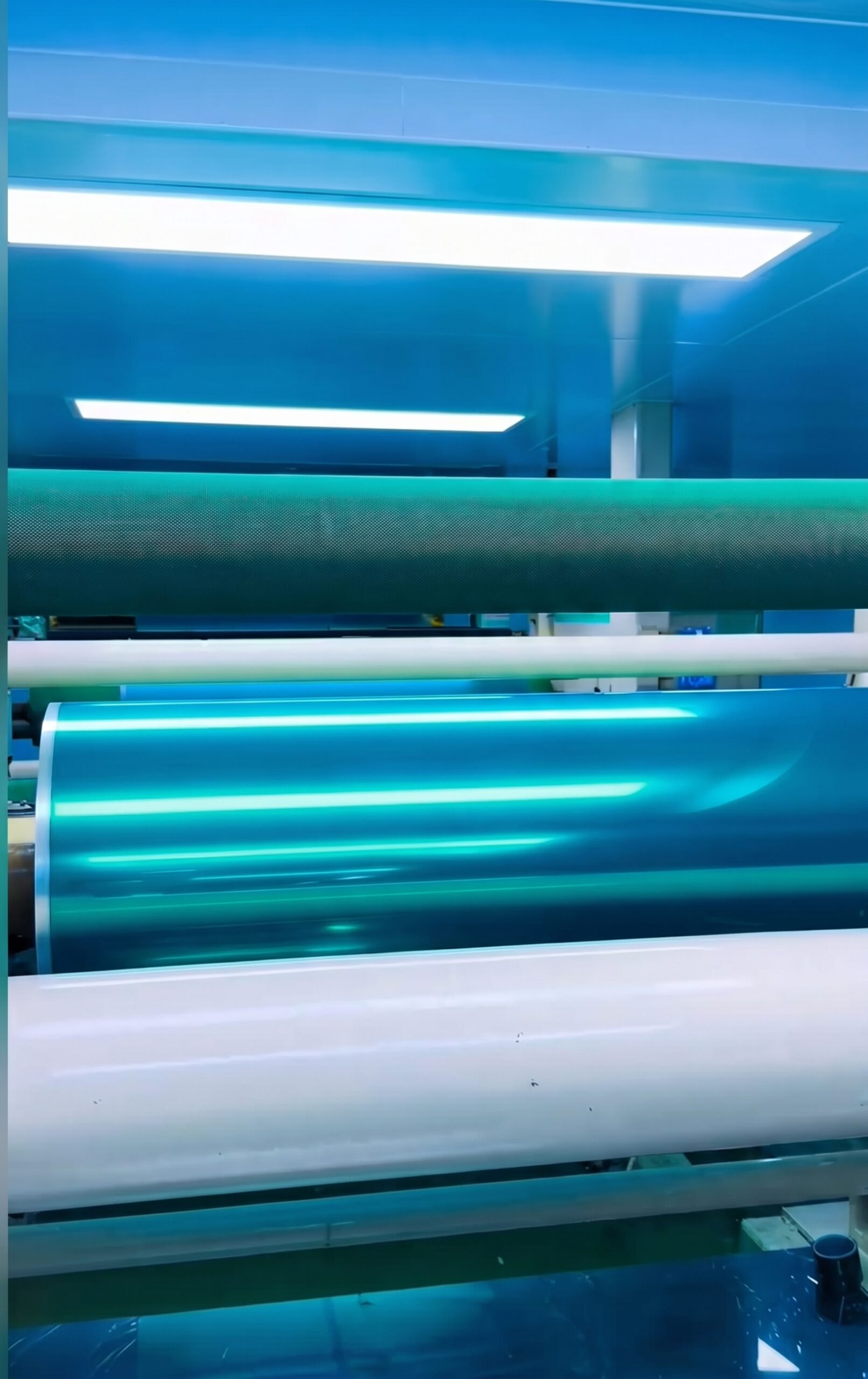
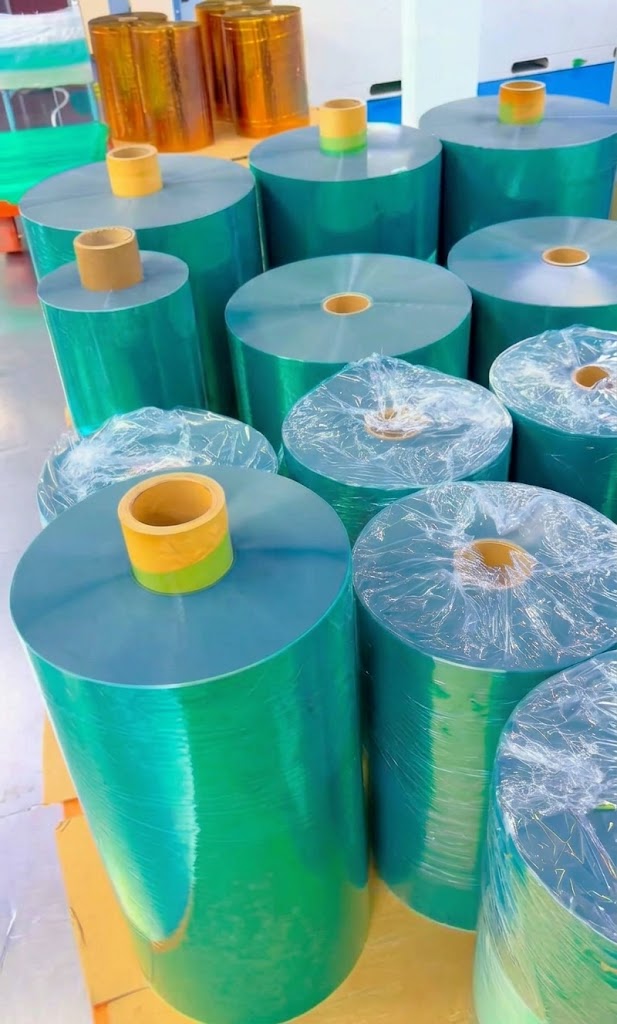
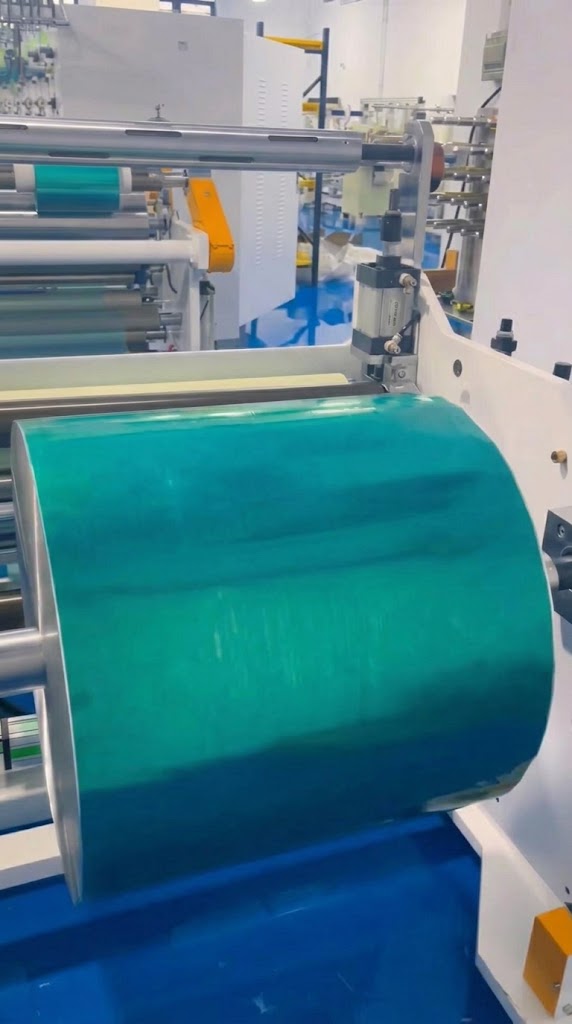
Coating: silicone adhesive is coated on PET film and wound into master rolls.
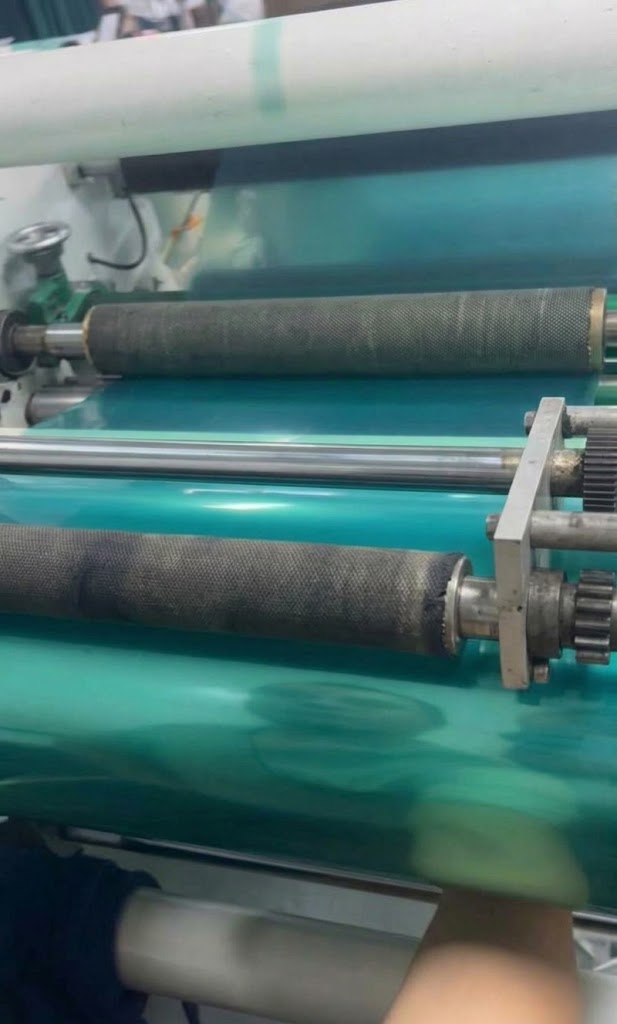
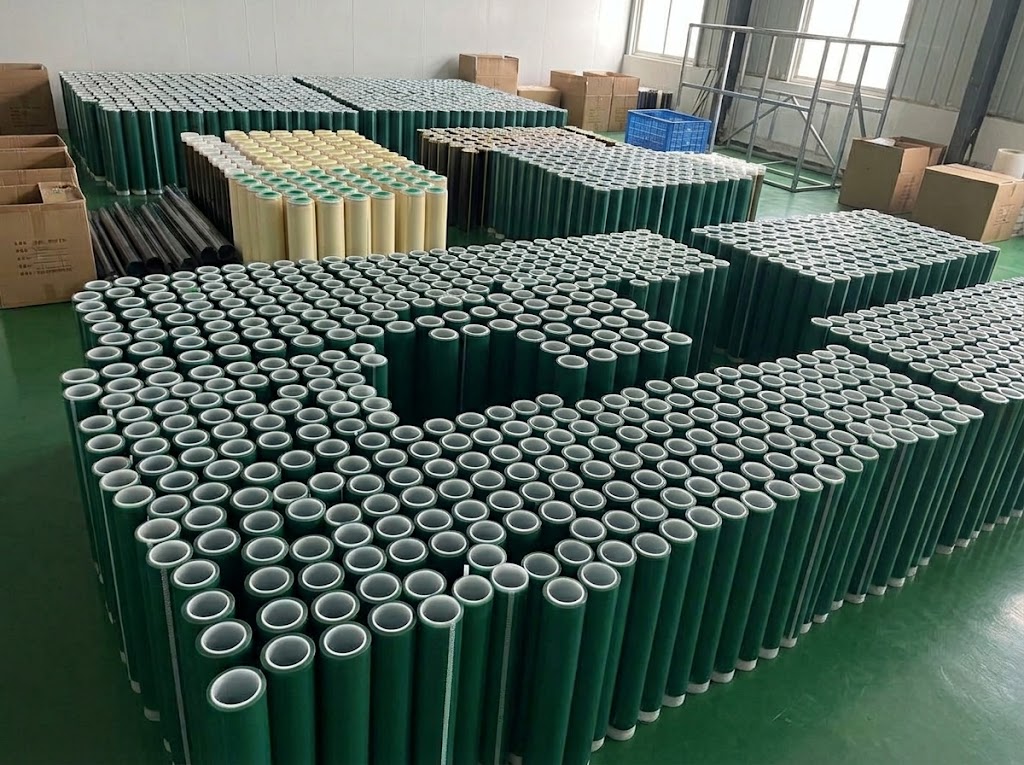
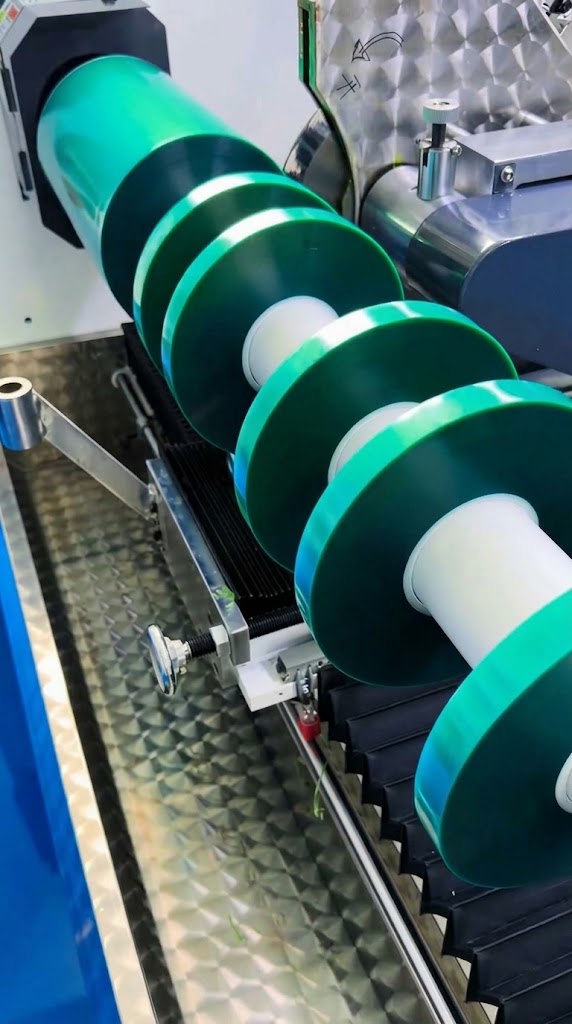
Converting: master rolls are rewound into log rolls and slit to the width you order.
- In-house testing laboratory
- QC department
- Incoming material inspection
- In-process control of thickness and adhesion, tested by batch
- Lot traceability
- Technical documentation on request: TDS; SDS where applicable
Learn about our manufacturing and converting capability and quality control and batch traceability.
Tools and Downloads
- Download TDS (PDF)
- View all datasheets
- Tape unit converter
- All tape tools
- Buying guides
- Comparison articles
- Troubleshooting
Frequently Asked Questions
What tape is used for powder coating masking?
A common choice is polyester (PET) film tape with silicone adhesive, which holds through the cure cycle and releases cleanly. P-350 uses this construction and is rated 392 °F (200 °C) for 30 minutes. For cure cycles beyond that rating, consider silicone polyimide tape and qualify it against its own data sheet.
Can regular masking tape be used for powder coating?
General-purpose masking tapes without a temperature rating for your cure cycle can scorch, lift or leave residue. Choose a tape rated for your actual temperature, time and removal needs. P-350 is a silicone-adhesive option; where silicone could affect later painting or bonding, test the masked area first.
What temperature can P-350 withstand?
392 °F (200 °C) for 30 minutes in our in-house oven test: the tape is applied to a steel panel, baked, cooled to room temperature and removed, with no shrinkage, curling or edge lift and one-piece, residue-free removal. Your parts, surfaces and removal timing differ from that test, and part temperature matters more than the oven setting, so verify on your heaviest part.
Which thickness should I choose?
As a starting point: P-350-50, 2.0 mil (0.05 mm), for curves and tight contours; P-350-80, 3.1 mil (0.08 mm), for flat or large areas and when one-piece removal matters; P-350-60, 2.4 mil (0.06 mm), for PCB etch and plating masking. Compare grades on your own parts with sample rolls.
When should the tape be removed after curing?
There is no single rule. Many coaters remove masking tape while the part is still warm; others get cleaner edges after partial or full cooling. Test both on the same part, vary the angle and speed, and check the edge, residue and tearing.
Do the blue, transparent and yellow versions perform differently?
No. They have the same properties as green; color only helps identification on the line.
Can P-350 be used where 3M™ 8992 or tesa® 50600 is specified today?
Customers looking for an alternative to these tapes have asked us about P-350, and some of these inquiries have led to orders. Compare the published data above: P-350-80 is rated 392 °F (200 °C) for 30 minutes and is supplied without a liner. Qualify it on your parts and cure cycle before changing a specification.
3M is a trademark of 3M Company. tesa is a registered trademark of tesa SE. River Tape is not affiliated with or endorsed by either company.
What do you need for samples or a quote?
For samples: your application, cure temperature and time, substrate and preferred grade. For a quote, add width, roll length and estimated annual volume. Small sample quantities are free; freight is paid by the customer. MOQ is 10,764 ft² (1,000 m²).
Request a Quote
Send your required width, roll length, operating temperature and estimated annual volume through the quote form below, or email info@rivertape.com.
Technical review: Jeremy Lin. Reviewed October 6, 2026.